OxPhos Revisited: A Five-Dimensional Comparative Analysis of Chemiosmosis and Conformons

Sungchul Ji, Ph.D.
Emeritus Professor of Theoretical Cell Biology
Rutgers University
Piscataway, New Jersey
1. Introduction: Beyond the Proton Gradient
For over six decades, Peter Mitchell’s chemiosmotic model of oxidative phosphorylation (OxPhos) [1, 2] has dominated bioenergetics. It offered a simple yet revolutionary view: electron transport generates a proton gradient (PMF), and this gradient powers ATP synthesis. But does this elegant model tell the whole story?
A growing body of evidence—mechanistic, quantum, and enzymological—suggests otherwise. The conformon model, co-developed by D.E. Green and myself in the early 1970s [3, 4], proposes that oxidative phosphorylation involves more than passive proton diffusion. It introduces conformons [5, 6]—quantized packets of mechanical energy and information—as the dynamic intermediates that couple respiration to ATP formation [7].
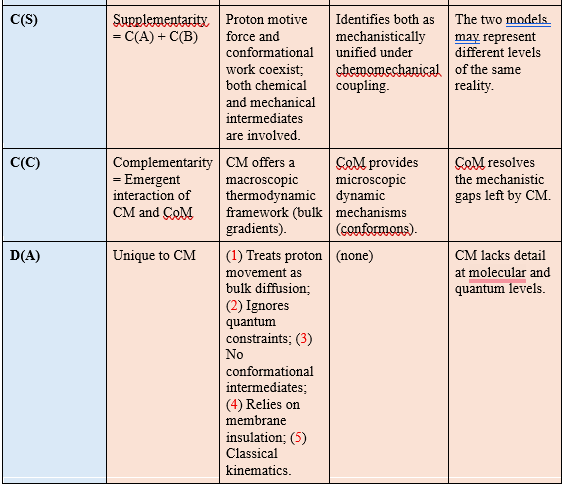
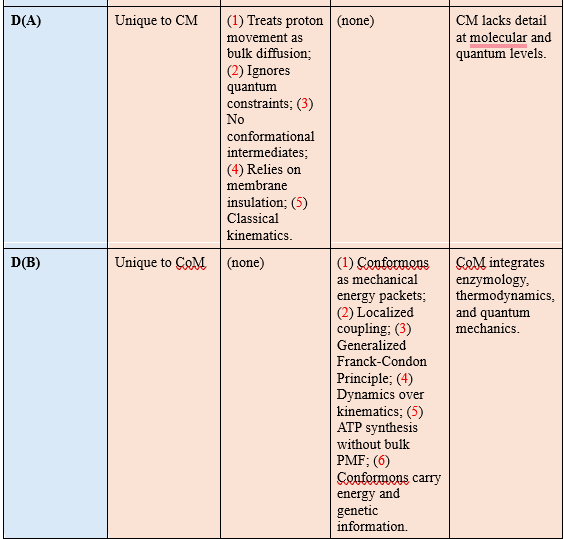
To clarify the relationship between these two frameworks, I present here a five-dimensional Venn-type comparative analysis (5VCA) recently developed in [8], distinguishing their commonalities, differences, and complementarities.

2. Diagrammatic Summary (Text Description)
Imagine two overlapping circles:
Circle A: Chemiosmotic Model (CM)
Circle B: Conformon Model (CoM)
The overlapping region includes:
Proton-driven ATP synthesis
ETC and ATP synthase as core machinery
Proton pumping as an essential function
The non-overlapping area of CM: D(A)
Bulk diffusion model
No mechanical intermediates
No quantum considerations
The non-overlapping area of CoM: D(B)
Conformons
Localized coupling and proton wires
Quantum mechanical and informational aspects
Generalized Franck-Condon Principle
The complementary space: C(C)
PMF is understood as a macro-effect
Conformons act as micro-mechanical causes
Chemiosmosis emerges from conformon-mediated dynamics
3. Conclusion: From Phenomenon to Mechanism
The chemiosmotic model gave us a phenomenological map: it pointed to what happens in OxPhos. The conformon model attempts to explain how it happens—by tracing the causal pathway from electron transfer through conformational changes to ATP synthesis.
As such, the conformon model may be viewed as not a rejection of chemiosmosis, but as its mechanistic and quantum-mechanical completion.
To borrow a metaphor: "The chemiosmotic model is to the conformon model what astrology is to astronomy."
Both gaze at the stars. But only one asks: what forces shaped them?
References:
[1] Mitchell, P. (1961). Coupling of phosphorylation to electron and hydrogen transfer by a chemiosmotic type of mechanism. Nature 191:144-148.
[2] Mitchell, P. (1966). Chemiosmotic coupling in oxidative and photosynthetic phosphorylation. Biol. Rev. 41: 445-502.
[3] Green, D. E. and Ji, S. (1972). The Electromechanochemical Model of Mitochondrial Structure and Function, in: Molecular Basis of Electron Transport (Schulz, J. and Cameron, B. F., eds.), Academic Press, New York, pp. 1-44.
[4] Ji, S. (1976). A Model of Oxidative Phosphorylation that Accommodates the Chemical Intermediate, Chemiosmotic, Localized Proton, and Conformational Hypotheses. J. theoret. Biol. 59, 319-330.
[5] Ji, S. (2000). Free energy and Information Contents of Conformons in proteins and DNA, BioSystems 54, 107-130.
[6] Conformons. https://en.wikipedia.org/wiki/Conformon
[7] Ji, S. (2025). Chemiosmotic vs Conformon Models of Oxidative Phosphorylation: Theory and Mechanistic Insights. BioSytems (in press).
[8] Ji, S. (2025). Bridging Global Conflicts and Inner Peace: Toward a Semiotic–Spiritual Synthesis. https://622622.substack.com/p/bridging-global-conflicts-and-inner
I reviewed Table 1 based on the new definitions of C(S) and C(C) as shown below:
C(S) Supplementarity: sum of A and B Proton gradient-driven ATP synthesis plus conformon-mediated ATP synthesis Proton gradient-driven ATP synthesis plus conformon-mediated ATP synthesis. C(S) = PMF-driven path + conformon-driven path. The total OxPhos mechanism includes both aspects.
C(C) Complementarity: A or B, depending on how C is observed. ATP synthesis appears PMF-driven under certain experimental setups (e.g., bulk pH gradients). ATP synthesis appears conformon-mediated under single-molecule or quantum-level observations.
This revised gable respects the original 2012 [1] definitions of complementarity and supplementarity while aligning with the 5VCA structure developed for Substack posts.
[1] Ji, S. (2012). Molecular Theory of the Living Cell: Concepts, Molecular Mechanisms, and Biomedical Applications. Springer, New York. Pp. 24-27.