The Tagore Transition
When an Ending Becomes the Appearance of a Larger Beginning
By Sungchul Ji, Ph.D.
Emeritus Professor of Theoretical Cell Biology, Rutgers University
with conceptual assistance from ChatGPT
Rabindranath Tagore once offered a memorable image of death:
“Death is not extinguishing the light; it is only putting out the lamp because the dawn has come.”
The power of this image lies in a subtle reversal.
From the viewpoint of the lamp, the light disappears. But from the wider viewpoint of dawn, illumination has not ended. A limited source of light has been overtaken by a more encompassing one.
The lamp has gone dark.
The world has not.
This poetic insight suggests a general pattern that may appear not only in reflections on death, but also in geometry, mathematics, psychology, cosmology, and the evolution of knowledge. I propose calling this pattern the Tagore transition.
A Tagore transition occurs when something that appears to terminate within one frame of reference may instead be understood as being transformed, superseded, or incorporated into a larger order.
It is the transition from lamp light to dawn light.
1. An Ending Seen from Two Perspectives
Many events look final when viewed locally.
A candle goes out.
A biological organism dies.
A familiar theory fails.
A psychological identity dissolves.
A cosmic era reaches its remote conclusion.
Yet the meaning of such events depends partly on the scale from which they are viewed.
The extinguishing of a lamp is a loss when the lamp is our only frame of reference. But if the sun is rising, the same event belongs to a larger transition from darkness to daylight.
The Tagore transition may therefore be expressed schematically as:

This does not mean that every ending conceals a new beginning. Nor does it prove that personal existence continues after death. It introduces a more modest possibility:
What disappears from one level of organization may persist differently, or become intelligible only within a wider level of organization.
2. The Geometric Archetype
A useful geometric analogy arises from the relationship between the tetrahedron and the 5-cell, also called the hypertetrahedron.
A tetrahedron is the simplest three-dimensional simplex. It has four vertices.
The 5-cell is the corresponding four-dimensional simplex. It has five vertices and cannot be fully visualized in ordinary three-dimensional space.
The transition may be written:

where the notation refers here to the passage from a four-vertex tetrahedral organization to a five-vertex hypertetrahedral organization.
From within three dimensions, the 5-cell is inaccessible as a complete visible object. We can represent it mathematically and examine its projections, but we cannot directly see its full four-dimensional structure.
The tetrahedron may therefore be compared to the lamp: visible, finite, and locally complete.
The 5-cell resembles the dawn: more encompassing, yet invisible from the lower-dimensional viewpoint.
The transition is not simply the addition of another point to a tetrahedron. A genuine 5-cell requires a new dimensional context. The original organization becomes part of something that cannot be fully contained within its former space.
This makes the tetrahedron-to-5-cell relation a geometric archetype of the Tagore transition:

3. The Dynamic Body-Centered Tetrahedron as Mediator
Between the tetrahedron and the 5-cell, I have proposed a simplex-like structure called the Dynamic Body-Centered Tetrahedron, or Dynamic BCT.
It consists of four fixed tetrahedral vertices and a fifth mobile point. Strictly speaking, it is not a simplex, because five points in three-dimensional space cannot form a true 4-simplex.
Its role is therefore not to replace the 5-cell but to represent mediation.
The Dynamic BCT may be understood as a changing three-dimensional projection of a higher-dimensional relationship. Its mobile point can occupy many positions, each expressing a different relational configuration.
This produces a three-part structure:

The Dynamic BCT is the interval in which the old structure remains visible while a more comprehensive organization begins to make itself felt.
In the language of the Tagore transition:
the tetrahedron is the lamp,
the 5-cell is the dawn,
and the Dynamic BCT is the changing horizon through which dawn becomes perceptible.
4. A Pattern Across Several Domains
The proposed concept becomes more interesting when similar transitions are placed side by side.
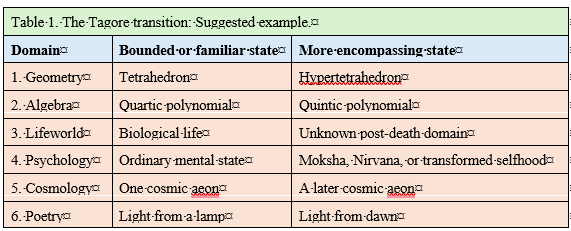
These examples are not mathematically identical. They belong to very different domains and carry different standards of evidence.
The value of the table lies elsewhere.
It identifies a recurring organizational motif:
A system reaches a boundary beyond which its previous framework is no longer sufficient, and a larger framework becomes necessary.
The Tagore transition names the existential meaning of that motif.
5. Algebra: From Quartic to Quintic
The passage from quartic to quintic equations provides an established mathematical example of a change in regime.
General polynomial equations of degree four or less can be solved by radicals. General quintic equations cannot.
The significance of Galois theory was not merely that it supplied another computational technique. It introduced a new organizing principle: the symmetry structure of the roots.
The old question was:
How do we write the solution?
The deeper question became:
What transformations among the roots determine whether such a solution is possible?
The transition from quartic to quintic therefore resembles a Tagore transition because the apparent failure of the old method opens the way to a more comprehensive mathematical viewpoint.
The lamp of radical formulas goes out.
The dawn of group theory appears.
6. Psychology: From Ordinary Identity to Transformation
Many philosophical and spiritual traditions describe a transition in which the ordinary ego or familiar mental structure is no longer treated as the whole of the person.
In Hindu and Buddhist traditions, terms such as moksha and Nirvana describe liberation from ordinary patterns of attachment, suffering, and limited identity. In Jungian psychology, individuation involves movement toward a more integrated Self.
These traditions should not be collapsed into one doctrine. Yet they share a broad image: transformation requires the loosening of a bounded identity.
From the standpoint of the ordinary self, this may feel like loss.
From the standpoint of the larger transformation, it may be liberation.
This is another possible Tagore transition:

The prior self is not necessarily destroyed. It is placed within a wider organization.
7. Cosmology: From the End of One Aeon to Another
Roger Penrose’s Conformal Cyclic Cosmology offers a striking modern example of an apparent ending becoming a transition.
In Penrose’s proposal, the unimaginably expanded future of one cosmic aeon may be conformally related to the Big Bang of the next. The end of one cosmological era is not necessarily the end of cosmic organization.
It becomes a boundary between aeons.
This does not prove cyclic cosmology, and it says nothing directly about personal survival after death. Yet it demonstrates that modern mathematical physics can reinterpret an apparent cosmic ending as a transformation into another phase.
In Tagore’s imagery:
the fading universe is the lamp,
the next aeon is the dawn,
conformal geometry is the mediating horizon.
8. Life, Death, and the Unknown
The most personally significant application concerns death.
Biologically, death is the irreversible cessation of the organism’s integrated functions. Science can describe many of the physical and cellular processes involved.
What science has not established is whether biological death exhausts every dimension of personhood, consciousness, or reality.
The Tagore transition does not answer that question. It changes how the question is framed.
Instead of assuming:

it permits the more cautious possibility:

without automatically concluding:

The distinction matters.
If consciousness is inseparable from biological organization, death may indeed end it. But if embodied consciousness is a partial manifestation of a deeper reality, death could represent a change in the relation between manifestation and source.
Geometry cannot prove this.
Poetry cannot prove it.
Cosmology cannot prove it.
But together they remind us that disappearance from one frame does not logically entail annihilation in every possible frame.
The lamp goes out.
Whether dawn has come remains an open question.
9. The Difference Between a Metaphor and a Law
The Tagore transition should be introduced carefully.
It is not presently a law of physics.
It is not a theorem.
It does not demonstrate that geometry, psychology, cosmology, and death share one causal mechanism.
It is a cross-disciplinary interpretive principle.
Its purpose is to direct attention toward a pattern that might otherwise be overlooked:
a bounded organization appears complete within its own domain;
that organization reaches a limit or undergoes dissolution;
a larger organizational framework becomes conceivable;
the apparent ending is reinterpreted from the standpoint of that larger framework.
Some examples are mathematically precise.
Others are philosophical.
Others remain speculative.
The strength of the concept lies not in erasing these distinctions but in allowing us to compare them responsibly.
10. A Proposed Definition
The term may be defined as follows:
A Tagore transition is an apparent termination, disappearance, or failure within a bounded frame that may be reinterpreted as transformation, supersession, or incorporation within a more comprehensive order.
A more compact formulation is:
The end of the lamp may be the beginning of dawn.
This definition captures both continuity and discontinuity.
The dawn is not the lamp prolonged indefinitely.
It is a different order of illumination.
Likewise, a higher-dimensional simplex is not merely a tetrahedron made larger. A new dimensional relation has appeared.
11. Three Forms of the Tagore Transition
The examples suggest at least three forms.
Structural transition
An existing organization becomes part of a higher-order structure.

Epistemic transition
The failure of an established method leads to a deeper framework.

Existential transition
The apparent ending of a familiar mode of being is interpreted as entry into an unknown or more encompassing one.

These forms need not share the same mechanism. Their similarity lies in their organizational logic.
12. Why Name the Pattern After Tagore?
Scientific and philosophical language often advances by naming a pattern that was previously difficult to see.
Tagore’s image deserves this role because it expresses the pattern with unusual economy.
His metaphor avoids two extremes.
It does not deny that the lamp goes out.
Nor does it assume that darkness follows.
It preserves the reality of loss while opening the possibility of a larger illumination.
That balance is essential.
A Tagore transition is not the claim that every loss is secretly good, or that death should not be grieved. The lamp mattered. Its light was real. Its extinguishing is real.
The metaphor says only that the local disappearance may not tell the whole story.
13. Conclusion: Beyond the Lamp
Human beings naturally interpret reality from within the scale they occupy.
We see three-dimensional projections, not complete four-dimensional objects.
We experience biological life from within life.
We interpret the failure of a theory from within the language of that theory.
We see the lamp go out.
The Tagore transition invites us to ask whether a wider frame exists.
Perhaps the deepest transitions in nature are not always movements from existence to nonexistence. Perhaps some are movements from one mode of organization to another.
The tetrahedron may become part of a hypertetrahedral order.
A failed algebraic method may give birth to a deeper theory.
An ordinary identity may open toward a more inclusive self.
One cosmic aeon may become the boundary condition of another.
And biological death—while remaining an undeniable ending within the observable lifeworld—may possibly belong to a transition whose larger meaning is not yet available to us.
We do not know whether dawn follows every extinguished lamp.
But Tagore’s image gives us a disciplined reason not to confuse the limits of our present light with the limits of reality itself.
The lamp goes out. The question is whether we are witnessing darkness—or sunrise.
Context. What is. Mathematically, a number of possibilities or infinite. A number of constraints and a number of variables. Do we choose context or context chooses us.