What Kind of Geometry Is the Geometry of Reality (GOR)?
GOR is not metaphorical but metametric — a geometry of relationships, transformations, and co-creation.
Sungchul Ji, Ph.D.
Emeritus Professor of Theoretical Cell Biology
Ernest Mario School of Pharmacy, Rutgers University, Piscataway, NJ
October 12, 2025
In defense of relational, not metric, geometry — and why “Spirit” belongs in the equation.
1. A Thoughtful Criticism
A reader recently raised an important challenge to the Geometry of Reality (GOR) framework.
They wrote:
“Everything can be construed as akin to GOR because GOR is not a well-defined concept. Descartes invented Cartesian geometry, and geometry means measuring the Earth. If you include qualitative parameters like an axis between matter and spirit, it all becomes an allegory. It’s not a geometry of anything that takes quant variables to define positions.”
This is a thoughtful objection, because it highlights the central philosophical tension at the heart of our project:
Can geometry, a science of measurement, describe phenomena that cannot (yet) be measured?
My answer is yes — but only if we recognize that geometry itself has evolved far beyond its Cartesian roots.
2. From Measuring the Earth to Mapping Reality
When René Descartes and Euclid spoke of “geometry,” they meant literal measurement — points, lines, and distances drawn on a measurable plane.
But the meaning of “geometry” has since expanded dramatically:
Riemann (1854) redefined geometry as the study of relationships of position, not measurement.
He showed that geometry can describe curved manifolds whose properties depend on internal structure rather than external yardsticks.Einstein (1915) extended this further: the geometry of spacetime is not Euclidean but dynamic, changing with the distribution of energy and matter. Geometry became the language of relations rather than of rulers and protractors.
Modern mathematics and physics introduced still broader geometries —
Topology, which studies continuity and connectivity rather than length.
Information geometry, where “distance” measures informational divergence.
Category theory, where geometry is expressed as networks of transformations and morphisms between structures.
In all of these, geometry is no longer about measurement, but about structure — the way things relate, transform, and cohere.
3. GOR as Relational Geometry
The Geometry of Reality (GOR) stands squarely in this modern lineage.
It is not a geometry of metric distances but of ontological relations.
Its three axes — Matter (Energy), Mind (Information), and Spirit (Meaning) — represent three fundamental modes of organization within the universe.
The X-axis (Energy) corresponds to measurable physical processes.
The Y-axis (Information) expresses communication and coordination — measurable in bits or couplings.
The Z-axis (Meaning or Spirit) represents the interpretive or contextual dimension — less quantifiable, but structurally essential for coherence, purpose, and emergence.
Together, they define a triadic manifold — a geometry not of space but of reality itself, encompassing the physical, mental, and spiritual domains.
4. Measurement vs. Mapping
The critic assumes that geometry must involve measurable quantities.
But geometry, in its most general form, is about mapping relationships, not necessarily measuring them numerically.
For example:
In phase-space geometry, axes represent state variables such as velocity and position — abstract but real.
In coordination dynamics, axes represent relative phases and coupling strengths — not physical coordinates but relations among oscillators.
In information geometry, distance corresponds to divergence between probability distributions — a relational measure of knowledge, not of space.
Similarly, GOR is a relational geometry: it maps how Energy (E), Information (I), and Meaning (M) co-vary and transform — a higher-order structure that unites matter, mind, and spirit.
5. Why Include “Spirit” or “Consciousness”?
Critics argue that consciousness cannot be quantified and therefore cannot serve as an axis.
But science already models many quantities we cannot directly measure — entropy, probability amplitude, curvature — through their measurable effects.
Likewise, the Z-axis of GOR need not be “spirit” in a theological sense; it is the dimension of context and interpretation — what in coordination dynamics corresponds to metastability or bifurcation thresholds.
It is not an arbitrary axis but the environmental or meaning-selective dimension — precisely what allows energy and information to form living, conscious, and adaptive systems.
6. Geometry Without Rulers
In GOR, “geometry” does not mean we can put a ruler on consciousness.
It means that we can describe the relational structure connecting physical, informational, and experiential dimensions.
This is similar to:
Topological geometry, which captures connectivity without metrics.
Category-theoretic geometry, which captures relationships between relationships.
Quantum geometry, which represents probabilities and superpositions rather than points in space.
GOR is thus a meta-geometry — a geometry of relations between domains of existence, rather than within one domain.
It is “geometry” in the same sense that Einstein’s geometry of spacetime is — relational, structural, and dynamic.
7. Coordination Dynamics as Empirical Bridge
Importantly, GOR is not purely philosophical.
It connects directly to Coordination Dynamics (Kelso & Haken), which mathematically describes how interacting oscillatory systems synchronize and transition between patterns.
In this mapping:
X (Energy) → physical oscillators and control parameters
Y (Information) → coupling and phase relationships
Z (Meaning/Spirit) → metastability, bifurcation, or contextual selection
This correspondence shows that the GOR triad is not allegorical but empirically grounded in the mathematics of coordination and self-organization.
In other words, GOR provides the philosophical form; coordination dynamics provides the quantitative content.
8. A Geometry of Becoming
Traditional geometry measures objects in space.
GOR, by contrast, maps relations in being — the ongoing transformation of energy into information and meaning through Iterative Reproduction with Variation and Selection by Environment (IRVSE).
It is not a geometry of what is, but of what becomes.
Thus, GOR should be understood as a living geometry — a geometry of process, coordination, and evolution, not of static quantities.
9. In Closing
To say that “Spirit cannot be measured” is true in the Cartesian sense — but reality has long outgrown Descartes.
Just as modern physics expanded geometry from flat space to curved spacetime, GOR expands it once more — into the triadic manifold of existence where Matter, Mind, and Meaning continually transform one another.
It is no longer about measuring the Earth.
It is about mapping the cosmos of relationships that make measurement possible in the first place.
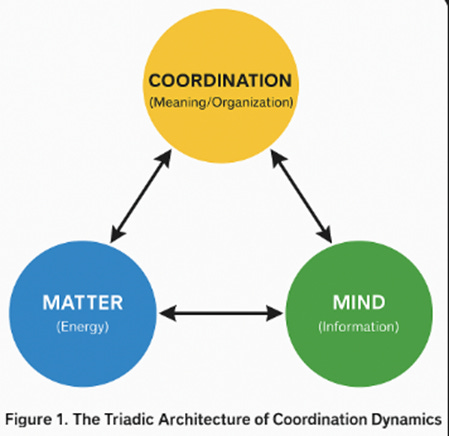
Figure 1. The Triadic Architecture of Coordination Dynamics
From Cartesian to Triadic Geometry. This diagram visualizes the conceptual transition from Cartesian geometry, which maps objects in space, to the Geometry of Reality (GOR), which maps relations in being.
The three colored circles—blue for Matter (Energy), green for Mind (Information), and gold for Coordination (Meaning/Spirit)—form a dynamic triangle connected by arrows of interaction.
Each side represents a channel of transformation: energy becomes information, information acquires meaning, and meaning guides energy’s organization.
Together, they express a triadic manifold in which reality organizes itself through the continuous interplay of energy, information, and meaning—a living geometry of becoming that extends the Cartesian plane into the relational domain of existence itself.
10. Author’s Note: The Evolution of Geometry
The Geometry of Reality (GOR) belongs to a lineage of thinkers who have gradually freed geometry from the tyranny of measurement:
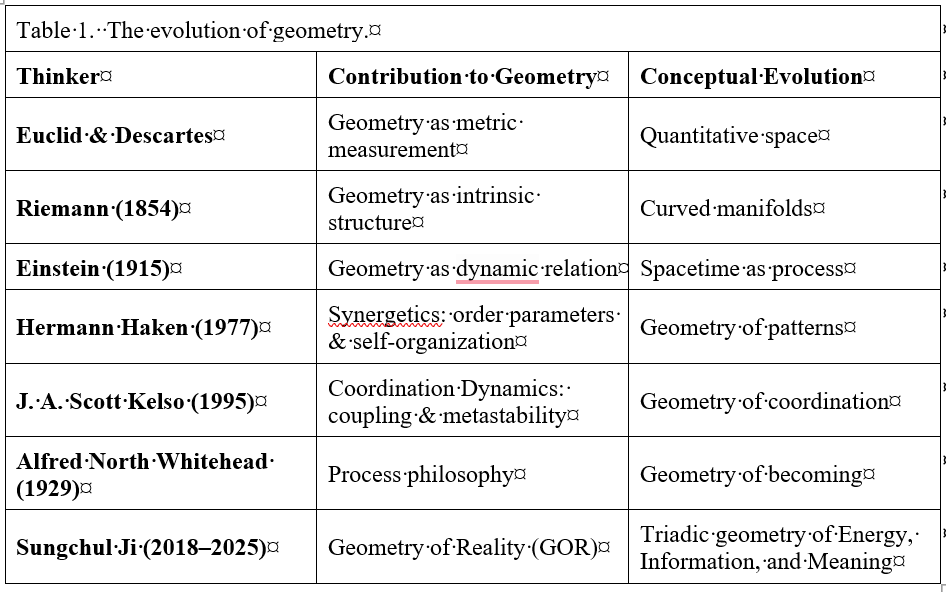
GOR thus extends the evolution of geometry beyond space and time into energy–information–meaning space, unifying physics, biology, and consciousness under a single triadic architecture.
In this sense, GOR is not metaphorical but metametric — a geometry of relationships, transformations, and co-creation.
What a wonderful expansion of thought and context. Thank you.
Reality = a 4-D Lorentzian spectral geometry, carrying gauge structure, fibered by an information geometry (Fisher/KL) that encodes observer-channel dynamics; the one-term action glues them, and all physics (GR, YM/EM, QM) follows from this unified geometric bundle.