Five-Dimensional Venn-Type Comparative Table (revied)
Chemiosmotic vs. Conformon Models of OxPhos

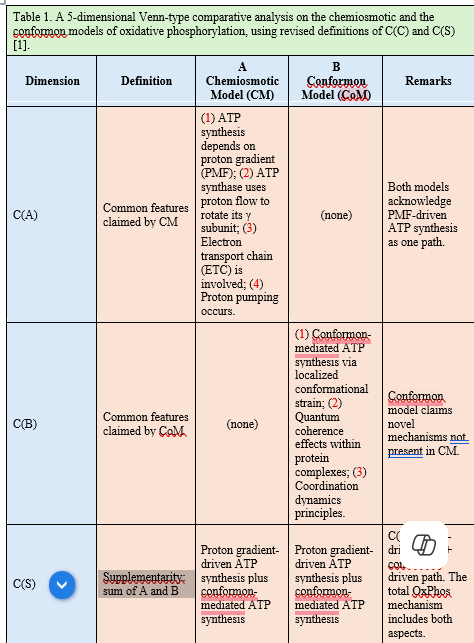
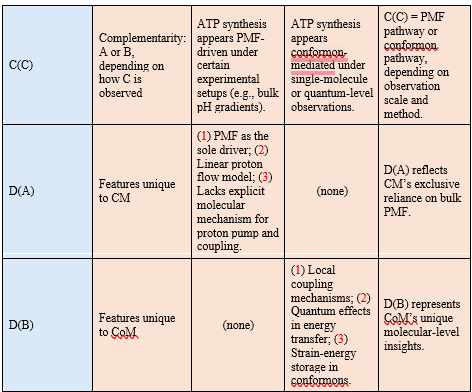
The revised definitions clarify that C(C) captures observational complementarity: the OxPhos system exhibits either CM-type behavior or CoM-type behavior depending on experimental resolution.
C(S) now explicitly means the integrated total OxPhos mechanism combining both proton gradient and conformon-mediated pathways.
This structure respects the original 2012 definitions of complementarity and supplementarity [2] while aligning with the 5VCA table developed in the Substack post available at [1].
References:
References:
[1] Ji, S. (2025). OxPhos Revisited: A Five-Dimensional Comparative Analysis of Chemiosmosis and Conformons. https://622622.substack.com/p/oxphos-revisited-a-five-dimensional
[2] Ji, S. (2012). Molecular Theory of the Living Cell: Concepts, Molecular Mechanisms, and Biomedical Applications. Springer, New York. Pp. 24-27.
I had to revise the 5-dimensional Venn-type comparative analysis of the chemiosmotic and the conforman models of OxPhos published on July 15, 2025, because I had wrong definitions of C(S) and C(C). The revised Substack post is attached below and the net changes resulting therefrom are summarized in Table 20 below.
(1) The effect of revising the definitions of C(S) and C(C) on the content of the 5-dimensional Venn-type comparative analysis (5VCA) of the chemiosmotic and the confromon models of oxidative phosphorylation (OxPhos).
The revised definition of C(S) and C(C) (see Definitions 5 and 6, in the first column of Table 20) are more consistent with the definitions of complementary and supplementarity originally given by Bohr (see Section 2 below) than Definitions 3 and 4. These definitional changes affected the content of the comparison table significantly, as can be seen in Column I and Column II, demonstrating that the 5VCA is a reliable method of comparing a pair of very complex texts and theories.
Table 20. The effect of changing the definitions of C(S) and C(C) on the structure of the 5-dimensional Venn-type Comparative Analysis table. Definitions before revision = 3 & 4; after revision = 5 & 6.
Definition
Before revision (I)
After revision (II)
1. A = Chemiosmotic model (CM)
(unchanged)
(unchanged)
2. B = Conformon model (CoM)
(unchanged)
(unchanged)
3. C(S) = Supplementarity = C(A) + C(B)
The two models may represent different levels of the same reality
(none)
4. C(C) = Complementarity = Emergent interaction of CM and CoM
CoM resolves the mechanistic gaps left by CM.
(none)
5. C(S) = Sum of A and B
(none)
Proton gradient-driven ATP synthesis plus conformon-mediated ATP synthesis
6. C(C) = Complementary union of A and B
(none)
ATP synthesis appears PMF-driven under certain experimental setups (e.g., bulk pH gradients).
ATP synthesis appears conformon-mediated under single-molecule or quantum-level observations
(2) The definitions of complementarity and supplementarity given by Niels Bohr.
(Excerpt from S. Ji, “Molecular Theory of the Living Cell: Concepts, Molecular Mechanisms, and Biomedical Applications,” Springer, New York, 2012. Pp. 24-27)
2.3 Complementarity
2.3.1 Complementarity vs. Supplementarity
The term “complementary” first appears in William James’ book, Principles of Psychology (1890), in the context of the idea that human consciousness consists of two parts:
“. . .in certain persons, at least, the total possible consciousness
may be split into parts which coexist but mutually ignore each
other, and share the objects of knowledge between them. More
remarkable still, they are complementary. . . . “
There is a great similarity between the concept of complementarity that James introduced into psychology in 1890 and that Bohr introduced into physics about four decades later. Whether Bohr’s complementarity was influenced directly or indirectly by James’ notion of complementarity is the challenging question whose solution is beyond the scope of this book and will have to be left for philosophers of science to decide.
The concept of complementarity emerged in 1926-7 from the intense discussions that transpired between Bohr and his then-assistant Heisenberg in the wake of the latter’s discovery of matrix mechanics and uncertainty relations (Lindley 2008). Bohr discussed his philosophy of complementarity in public for the first time at a meeting held in Como, Italy, in 1927 and published the first paper on complementarity in 1928 (Bohr 1928). In 1958, Bohr summarized the concepts of supplementarity and complementarity as follows (Bohr 1958):
" . . . Within the scope of classical physics, all characteristic (2-29)
properties of a given object can in principle be ascertained by
a single experimental arrangement, although in practice various
arrangements are often convenient for the study of different
aspects of the phenomenon. In fact, data obtained in such a
way simply supplement each other and can be combined into
a consistent picture of the behavior of the object under
investigation. In quantum mechanics, however, evidence about
atomic objects obtained by different experimental arrangements
exhibits a novel kind of complementary relationship.
Indeed, it must be recognized that such evidence which
appears contradictory when combination into a single picture
is attempted, exhausts all conceivable knowledge about the
object. Far from restricting our efforts to put questions to nature
in the form of experiments, the notion of complementarity
simply characterizes the answers we can receive by such inquiry,
whenever the interaction between the measuring instruments
and the objects forms an integral part of the phenomenon. . . .
(my italics) "
The supplementary and complementary relations defined above can be conveniently represented as triadic relations among three entities labeled A, B, and C. Supplementarity refers to the relation in which the sum of a pair equals the third:
Supplementarity: C = A + B (2-30)
As an example of supplementarity, Einstein’s equation in special relativity, E = mc2 may be cited. Energy (A) and matter (B) may be viewed as extreme manifestations of their source C that can be quantitatively combined or added to completely characterize C. As already indicated there is no common word to represent the C term corresponding to the combination of matter and energy. Therefore, we will adopt in this book the often-used term “mattergy” (meaning matter and energy) to represent C. Through Einstein’s equation, matter and energy can be interconverted quantitatively. The enormity of the numerical value of c2, namely, 1021, justifies the statement that
"Matter is a highly condensed form of energy." (2-31)
In contrast to supplementarity, complementarity is nonadditive: i.e., A and B
cannot be combined to obtain C. Rather, C can be said to become A or B depending on measuring instruments employed: i.e., C = A or C = B, depending on the measuring apparatus employed. We can represent this complementary relation symbolically as shown in Eq. (2-32):
Complementarity: C = A^B (2-32)
where the symbol ^ is introduced here to denote a “complementary relation”. Eq. (2-32) can be read in two equivalent ways:
“A and B are complementary aspects of C. “ (2-33)
“C is the complementary union of A and B.” (2-34)
Statements (2-33) and (2-34) should be viewed as short-hand notations of the deep philosophical arguments underlying complementarity as, for example, discussed recently by Plotnitsky (2006).
References:
James, W. (1890). The Principles of Psychology, Volume One, Dover Publications, Inc., New York. P. 206.
Lindley, D. (2008). Uncertainty: Einstein, Heisenberg, Bohr, and the Struggle for the
Soul of Science, Anchor Books, New York.
Bohr, N. (1928). The quantum postulate and the recent developments of atomic theory, Nature 121, pp. 580–590.
Plotnitsky, A. (2006). Reading Bohr: Physics and Philosophy, Kindle Edition, Springer.