Nonlocality as Simplicial Integration in Simplicial Group Theory (Table 4 Revised): From Galois Groups to Bohmian Mechanics Mar 26, 2026
Sungchul Ji, Ph.D.
Emeritus Professor of Theoretical Cell Biology
Rutgers University
Keywords
Quantum nonlocality; Bohmian mechanics; quantum potential; Galois theory [7, 7a, 7b]; symmetric groups [8]; simplicial geometry; 4-simplex; Simplicial Group Theory [5]; integration; emergence
1. Introduction
Quantum mechanics has long challenged classical intuitions regarding locality and separability. In particular, quantum entanglement and nonlocal correlations suggest that the behavior of a system cannot be fully described in terms of independent local components. In Bohmian mechanics [2, 3, 4], this feature is made explicit: particle dynamics are governed by a quantum potential [10] that depends on the configuration of the entire system.
In parallel, Galois theory [7, 7a, 7b] demonstrates that the solvability of polynomial equations is determined by the structure of their symmetry groups. The transition from quartic to quintic equations corresponds to a shift from the solvable symmetric group to the non-solvable group , marking a fundamental change in algebraic structure.
In this paper, we propose that these two phenomena—algebraic non-solvability and quantum nonlocality—reflect a common underlying principle: the emergence of irreducible global integration [5]. We develop this idea within the framework of Simplicial Group Theory (SGT) [5], which relates symmetry groups to simplicial geometry and ontological organization.
2. Symmetry Groups and Simplicial Geometry

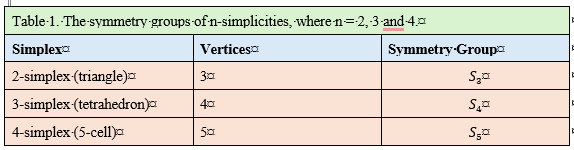
This correspondence establishes a direct connection between geometric structure and algebraic symmetry [8]..
3. The S4 —> S5 Threshold .
A central result of Galois theory [7, 7a, 7b] states that a polynomial equation is solvable by radicals if and only if its Galois group is solvable. The symmetric group is solvable, whereas is not.
This implies a qualitative transition:
S4: decomposable symmetry
S5 : non-decomposable symmetry
We interpret this transition as a shift from structured relations to irreducible integration, where system behavior can no longer be reduced to simpler independent components.
4. Simplicial Group Theory (SGT)
Simplicial Group Theory extends this algebraic insight into a geometric–ontological framework. We associate simplicial levels with emergent organizational categories:
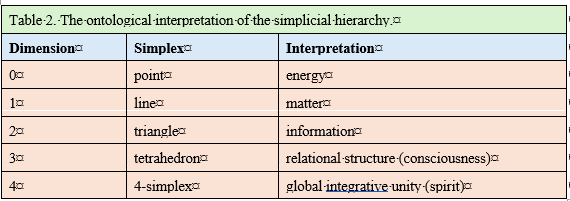
The tetrahedron represents a system of distributed relations, while the 4-simplex introduces an additional vertex connected to all others, forming a globally integrated structure.
5. Bohmian Mechanics and the Quantum Potential
In the formulation of Bohmian mechanics (de Broglie–Bohm theory) [2, 3, 4], particle motion is governed by a quantum potential:

This potential exhibits the following properties:
dependence on the entire configuration of the system
intrinsic nonlocality
independence from local energy transfer
sensitivity to global wavefunction structure
Thus, the quantum potential acts as a global constraint rather than a local force.
6. The Fifth Vertex as Integrative Principle
The 4-simplex introduces a fifth vertex that connects to all other vertices. This vertex is:
irreducible to pairwise interactions
globally connected
structurally integrative
We propose the following correspondence:
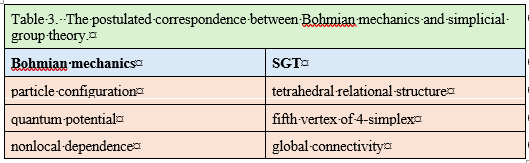
Thus, the fifth vertex serves as a geometric analog of the quantum potential.
7. Nonlocality as Simplicial Integration
From this perspective, quantum nonlocality is not anomalous but reflects a deeper geometric principle. The transition:

marks the emergence of a structure that cannot be decomposed into independent parts. This corresponds to the appearance of global constraints governing system behavior.
We therefore propose:
“Quantum nonlocality is the physical manifestation (3/26/2026/2)
of simplicial integration at the level.”
8. Structure–Integration–Transformation Triad
The framework naturally yields a triadic principle:
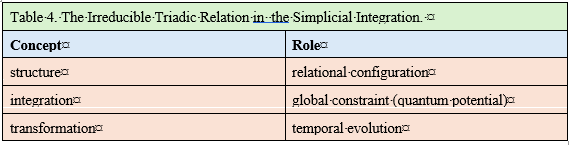
Thus:

This triad provides a unifying principle across physical, biological, and semiotic domains.
9. Discussion
The proposed framework suggests that:
algebraic non-solvability and quantum nonlocality share a common structural origin
higher-dimensional simplicial geometry provides a natural representation of global integration
physical systems may be governed by integrative constraints not reducible to local interactions
This perspective aligns with Bohm’s notion of implicate order [11] and extends it into a geometric–algebraic framework.
10. Conclusion
We have proposed that quantum nonlocality can be understood as the manifestation of simplicial integration associated with the symmetry group. The fifth vertex of the 4-simplex provides a geometric representation of the quantum potential, unifying algebraic, geometric, and physical concepts within a single framework.
References
[1] Quantum nonlocality. https://en.wikipedia.org/wiki/Quantum_nonlocality
[2] Bohm, D. (1952). A suggested interpretation of the quantum theory in terms of “hidden variables”. Physical Review, 85, 166–193.
[3] Goldstein, S. (2017). Bohmian mechanics. Stanford Encyclopedia of Philosophy.
[4] Bohm, D., & Hiley, B. J. (1993). The Undivided Universe. Routledge.
[5] Ji, S. (2026). Simplicial Group Theory. https://622622.substack.com/p/simplicial-group-theory-sgt
[6] 5-Cell. https://en.wikipedia.org/wiki/5-cell
[7] Galois, É. (1832). Mémoire sur les conditions de résolubilité des équations.
[7a] Stewart, I. (2004). Galois Theory. Chapman & Hall.
[7b] Stillwell, J. (2010). Mathematics and Its History. Springer.
[8] Symmetry group. https://en.wikipedia.org/wiki/5-cell
[9] Simplcial complex. https://en.wikipedia.org/wiki/Simplicial_complex
[10] Quantum potential. https://en.wikipedia.org/wiki/Quantum_potental.
[11] Bohm, D. (1980). Wholeness and the Implicate Order. Routledge.