Simplex vs. Complex: A False Disjunction in the Geometry of Reality
Why projections from a 4-simplex are not “empty”—but foundational
Sungchul Ji, Ph.D.
Emeritus Professor of Theoretical Cell Biology
Rutgers University
1. A Critique Worth Taking Seriously
In response to my recent Substack article on Gnomonics and the Geometry of Reality (https://622622.substack.com/p/gnomonics-and-the-geometry-of-reality), I received the following criticism:
“The problem is your use of simplexes without simplicial complexes… you are just projecting one simplex onto another… the real mathematics lies in complexes and global topology.”
At first glance, this sounds like a standard technical objection from topology.
And indeed, it contains a kernel of truth.
But it also rests on a deeper misunderstanding—one that reveals a classic logical error.
2. What Is Being Confused?
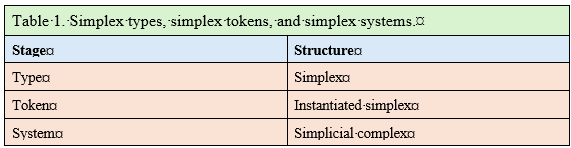
Let us distinguish three levels:
Level 1: Simplex (Type)
A simplex is an irreducible geometric form:
Point (0-simplex)
Line (1-simplex)
Triangle (2-simplex)
Tetrahedron (3-simplex)
5-cell (4-simplex)
These are not “objects in space” alone—they are generative geometric types.
Level 2: Tokens (Instances)
A simplex becomes physically meaningful when instantiated:
A particular tetrahedron in a structure
A specific interaction event
A localized configuration
These are tokens of the type [1].
Level 3: Simplicial Complex (System)
A simplicial complex is:
A structured network of simplex tokens.
Examples include:
Surfaces (sphere, torus)
Higher-dimensional manifolds
Topological spaces
3. The False Disjunction Bias
The criticism assumes:
“If your theory does not describe complexes, it explains nothing.”
This is a textbook example of what I have called:
False Disjunction Bias (FDB) [2]
It falsely separates:
Local generative structure (simplex)
Global organization (complex)
as if one excludes the other.
But in reality:
Complexes presuppose simplexes.
4. What My Work Actually Addresses
My work is not primarily about:
classifying topological spaces
computing homology groups
describing global connectivity
Instead, it addresses a deeper question:
How does reality become observable?
This is a problem of:
projection
dimensional reduction
selection
5. From Geometry to Observation: The Role of Projection
The central idea in Gnomonics and the Geometry of Reality is:
We do not observe reality directly—we observe its projections.
A 4-simplex (5-cell) represents:
a higher-dimensional generative structure
Its projection into 3D produces:
shadows, slices, and apparent objects
This is analogous to:
Plato’s cave
quantum measurement
biological observation
6. Where Do Complexes Come From?
Here is the key point that resolves the debate:
Simplicial complexes are not primary—they are generated.
In my framework, the generator is:
IRVSE [3]
Iterative Reproduction with Variations followed by Selection by Environment
Triadic Mapping
And the process is:
Simplex → (IRVSE) → Tokens → Organized Complex
7. The Missing Layer in Standard Topology
Topology [4] typically studies:
the final structure (complex)
But it does not ask:
How was this structure generated?
Why this structure and not another?
What selects among possibilities?
8. The Role of Selection (Z-axis in GOR)
In the Geometry of Reality (GOR) [5]
X = Matter
Y = Information
Z = Selection / Spirit
Simplicial complexes live largely in:
the XY plane (structure and relations)
But their formation requires:
Z: a selection principle
9. A Deeper Insight
We can now see:
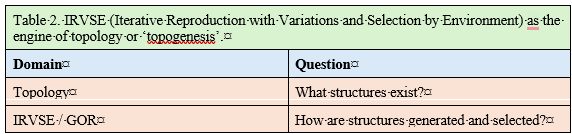
Topology describes what is.
IRVSE explains how it becomes.
Or more precisely:
10. Turning the Critique Around
The criticism says:
“You are only projecting simplexes.”
But projection is not a weakness—it is the key.
Because:
Observation itself is a projection.
Thus:
Physics = projections of higher-dimensional states
Biology = projections of molecular dynamics
Consciousness = projection of internal states
11. The Real Synthesis
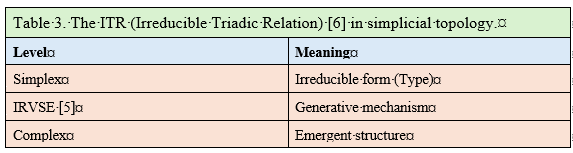
Rather than opposing the two views, we can unify them:
Triadic Geometry of Structure
12. Final Insight
The criticism assumes that:
Only global topology is meaningful.
But this overlooks a deeper truth:
“Without generative forms and selection mechanisms, (4/5/2026/1)
topology is descriptive—but not explanatory.”
13. Conclusion
My work does not deny simplicial complexes.
It simply asks a prior question:
What generates them, and how do we observe them?
The answer lies in:
simplexes as irreducible geometric types (4/5/2026/2)
IRVSE as the generative mechanism
projection as the bridge to observation
One-Sentence Summary
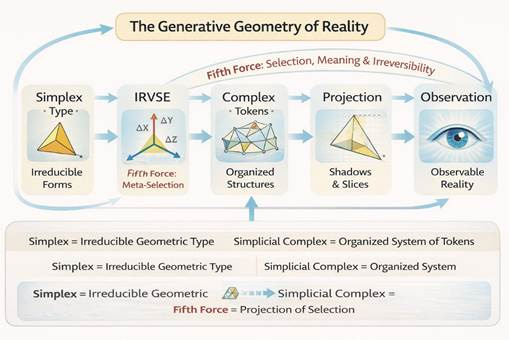
“Simplicial complexes describe the architecture of reality, (4/5/2026/3)
but simplexes and IRVSE explain its genesis.”
Optional Subtitle Variations
“Why topology without generation is incomplete”
“From simplexes to reality: resolving a geometric misunderstanding”
“Projection is not trivial—it is how reality appears”
References:
[1] Type-token distinction. https://en.wikipedia.org/wiki/Type%E2%80%93token_distinction
[2] False dilemma.https://en.wikipedia.org/wiki/False_dilemma
[3] Ji, S. (2025). The Geometry of Reality (GOR): A Triadic Framework for Matter, Mind, and Spirit. https://622622.substack.com/p/geometry-of-reality
[4] Topology. https://en.wikipedia.org/wiki/Topology
[5] Ji, S. (2025). The Geometry of Reality (GOR): A Triadic Framework for Matter, Mind, and Spirit. https://622622.substack.com/p/geometry-of-reality
[6] Ji, S. (2018). The Cell Language Theory: Connecting Mind and Matter. World Scientific Publishing, New Jersey. Pp. 377-393. The Universality of ITR