The Hidden Translator Inside You
How Your Brain Turns Electrical Signals into Thought — and Why That Changes Everything
Based on research by Sungchul Ji, Ph.D., Emeritus Professor, Rutgers University
Here is one of the most mind-bending questions in all of science: How does a lump of grey tissue — billions of neurons firing electrical pulses at each other — somehow produce the rich, colorful, meaningful experience of being you? How does the physical become personal? How does a signal become a thought?
For decades, scientists and philosophers assumed the answer was straightforward: brain activity simply is meaning. Neurons fire in a certain pattern, and that pattern carries the thought. End of story.
But recent research suggests that story is missing a crucial chapter. There is something in between the signal and the meaning — a hidden translator. And understanding it may change how we think about consciousness, medicine, and even the nature of life itself.
The Problem with Going Direct
Philosopher Cathy Reason [1] recently published a theorem — a logically airtight argument — claiming that brain activity alone cannot directly produce meaning. She calls this the No-Supervenience Theorem. In plain English: you cannot simply trace a straight line from “neurons firing” to “the meaning of a thought.” Something is missing in that gap.
Think of it like trying to get music directly from electricity. Yes, electricity powers your speaker — but you cannot plug a wire into a wall and call that music. There is something in between: a device that interprets the electrical signal and translates it into sound. The translation step is not optional. It is everything.
So if the brain cannot jump straight from electrical activity to meaning, what is doing the translating?
Nature’s Bar Codes
To understand the proposed answer, we need to talk about QR (Quick Response) codes — those square black-and-white patterns you scan with your phone to open a website or menu. A QR code is a middle layer. It takes complex information (a web address, a payment, a message) and compresses it into a simple, scannable pattern. Then a reader interprets that pattern and turns it back into meaning.
Researcher Sungchul Ji at Rutgers University has found that biology appears to work the same way — at multiple levels of life.
“The path from matter to meaning is not a straight line. It is a three-step bridge: Dynamics → Code → Meaning.”
RNA QR Codes: Reading the Cancer Barcode
Every cell in your body is constantly producing proteins using genetic instructions called mRNA. When a tumor forms, thousands of genes change their activity all at once — it is enormously complicated data, like trying to read millions of lines of text simultaneously.
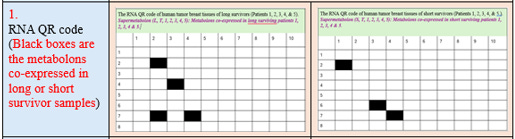
Ji’s team discovered that you can compress this overwhelming complexity into a simple binary code — a pattern of 1s and 0s, like a biological QR code [2, 3]. Each position in the code represents a cluster of genes (called a metabolon). A “1” means those genes are working together actively; a “0” means they are quiet. The result is an RNA QR code — a compact snapshot of an entire tumor’s molecular identity.
The stunning part? Once you have that code, you can translate it into a clinical sentence: “If this tumor is treated with Drug X, the patient is likely to survive Y months.” The raw molecular chaos becomes an actionable, human-readable prediction — but only because the QR code served as a translator in the middle.
Millions of gene signals → RNA QR Code → Clinical Prediction
EEG QR Codes: Reading the Brain’s Signature
The same logic applies to the brain [4].
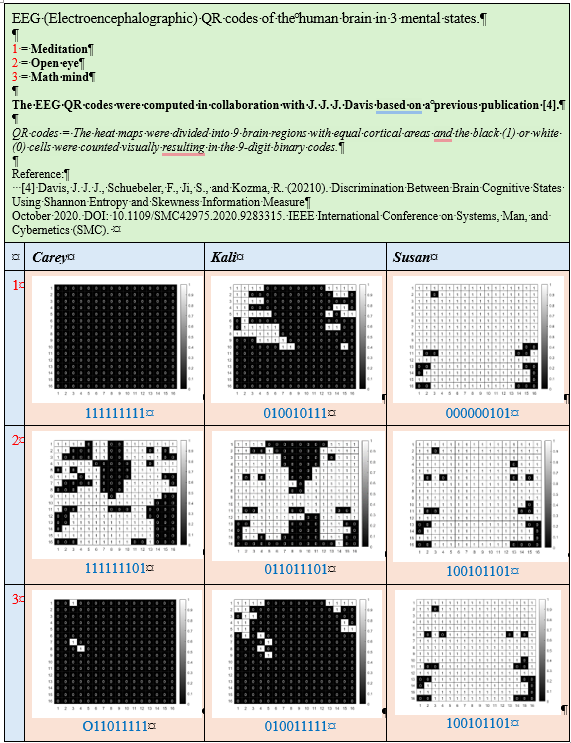
An EEG (electroencephalogram) measures the electrical activity across your scalp as thousands of neurons fire. The raw data is a torrential storm of waves and oscillations — nearly impossible to interpret directly.
Ji and Davis [4] found that they could divide the brain into nine regions and create a similar binary snapshot. Each region’s activity is coded as active (1) or quiet (0), producing a 9-digit EEG QR code. Different mental states — deep meditation, alert open-eye awareness, intense mathematical reasoning — each produce a distinct, recognizable code.
The electrical storm in your brain does not directly become the thought. It first becomes a code. The code is then interpreted. Only then does the thought have meaning.
Brain electrical activity → EEG QR Code → Cognitive state (e.g., “Meditation”)
The Missing Piece: Three Is the Magic Number
Here is where things get philosophically thrilling. This pattern — physical signal, then code, then meaning — has appeared throughout the history of ideas, often without scientists realizing they were all describing the same underlying structure.
In the 1800s, the American philosopher Charles Sanders Peirce [5] proposed that all meaning in the universe arises through a three-part structure he called a triadic sign relation: a Sign, an Object, and an Interpretant.
The Sign is the physical thing that carries the message (the word “fire,” the smell of smoke, an EEG pattern).
The Object is what the sign refers to (actual flames, a tumor’s metabolic state, the experience of calm).
The Interpretant is the meaning produced in someone’s (or something’s) mind — the understanding that results.
Crucially, Peirce argued you cannot reduce this to just two parts [6]. You cannot skip the middle step. Try to go directly from sign to meaning, and the whole system collapses. This is exactly what Reason’s No-Supervenience Theorem [1] proves mathematically: you cannot go straight from brain dynamics to meaning without something in between.
Ji’s QR codes are not just a clever data analysis trick. They are a concrete, biological demonstration of Peirce’s triadic principle at work — in cancer cells and in human brains.
Cellese and Humanese: Two Languages of Life
Ji has a beautiful way of framing this. He proposes that living cells have their own language — a molecular tongue he calls Cellese [7]. It is written in the activity patterns of genes, enzymes, and proteins — a silent language spoken by every cell in your body from the moment you were conceived.
The problem is, we do not naturally speak Cellese. Doctors need to understand what a tumor is “saying.” Neuroscientists need to know what a brain state “means.” RNA and EEG QR codes are, in this sense, translation devices — they convert Cellese into Humanese: the language of human understanding, clinical statements, and actionable insight.
This is not a metaphor. It is a precise structural claim: biological information requires an interpreter, just as a foreign language requires a translator. And without that translation layer — the code in the middle — meaning cannot cross from one domain to another.
Why This Changes Everything
If this triadic model [8] is correct, it has sweeping implications across multiple fields:
For medicine: We can build smarter diagnostic tools that do not just measure biology — they interpret it, translating molecular chaos into medical decisions.
For neuroscience: Brain scans may eventually read mental states with enough precision to assist patients who cannot communicate — decoding the language of a mind trapped inside a body.
For the philosophy of mind: Consciousness may not be a mysterious property that “emerges” from neurons in some hand-wavy way — it may be a systematic translation process, and that process might be precisely describable.
For artificial intelligence: Building systems that truly understand — rather than just pattern-match — may require building in this triadic architecture: the ability to generate codes and interpret them, not just process inputs and produce outputs.
The Bridge Between Worlds
For centuries, the gap between the physical and the meaningful felt like a chasm — the hardest problem in science and philosophy. How can something as cold and mechanical as electrical impulses give rise to something as warm and personal as a thought, an emotion, a sense of self?
The answer may be that they are never in direct contact. They never have to be. Between them stands a translator — a code, a structured intermediary — doing the invisible work of converting signal into sense.
Your brain does not magically turn electricity into thought. It first turns electricity into a kind of language, and then reads that language, and from the reading produces experience. The magic was never in the electricity. It was always in the translation.
Dynamics → Code → Meaning. This three-step bridge may be the universal architecture of life itself.
The work of Ji and his colleagues suggests this is not merely a poetic idea. It is a testable, mathematical, biological reality — visible in cancer cells, in brainwaves, and perhaps in the very informational fabric of all living things [8].
Key Concepts Glossary
Supervenience: The idea that mental states are fully determined by physical brain states — the “brain = mind” assumption.
mRNA / Transcriptomics: mRNA molecules carry genetic instructions from DNA to the cell’s protein-making machinery. Transcriptomics measures the activity levels of thousands of genes at once.
Metabolon: A cluster of genes that work together to perform a related metabolic function inside the cell.
EEG (Electroencephalogram): A device that measures electrical activity across the scalp, reflecting patterns of brain activity.
Triadic semiosis: Charles Peirce’s model of meaning-making, which requires three elements — sign, object, and interpretant — and cannot be reduced to a two-part relationship.
Cellese / Humanese: Ji’s metaphor for the molecular language of cells (Cellese) and the human-interpretable language of
References:
[1] Reason, C. M. (2023). A Formalizable Proof of the No-Supervenience Theorem: A Diagonal Limitation on the Viability of Physicalist Theories of Consciousness. arXiv preprint (June 8, 2023).
[2] Ji, S. (2026). Traditional QR codes vs RNA QR codes. https://622622.substack.com/p/traditional-qr-codes-vs-rna-qr-codes
[3] Ji, S. (2025). Announcing the Human Transcriptome Project: Unlocking the Hidden Language of Our Cells: Unlock the hidden language of your cells with the Human Transcriptome Project. https://622622.substack.com/p/announcing-the-human-transcriptome
[4] Davis, J. J. J., Schuebeler, F., Ji, S., and Kozma, R. (20210). Discrimination Between Brain Cognitive States Using Shannon Entropy and Skewness Information Measure. October 2020. DOI: 10.1109/SMC42975.2020.9283315. IEEE International Conference on Systems, Man, and Cybernetics (SMC).
[5] Semiotic theory of Charles Sanders Peirce.https://en.wikipedia.org/wiki/Semiotic_theory_of_Charles_Sanders_Peirce
[6] Ji, S. (2026). When Two Is Not Enough. https://622622.substack.com/p/When-Two-Is-Not-Enough
[7] Ji, S. (2018). The Cell Language Theory: Connecting Mind and Matter. World Scientific Publishing, New Jersey.
[8] Ji, S. (2026). From Brain Dynamics to Meaning: Do RNA QR Codes Bridge the Gap? https://622622.substack.com/p/brain-dynamics-to-meaning-do
My brain is still trying to assimilate all this fascinating information.