Three Roads Toward Consciousness: Substance, Operators, and Saddle Points
Sungchul Ji, Ph.D.
Emeritus Professor of Theoretical Cell Biology
Rutgers University
What comes first—soul, mathematical operators, or the dynamics of transition?
For centuries, philosophers, theologians, and scientists have struggled with one of humanity’s oldest questions:
What gives rise to consciousness?
Despite remarkable advances in neuroscience, physics, and artificial intelligence, no universally accepted answer has emerged. Yet an illuminating exchange between two contemporary thinkers—Mohammad Shafiq Khan [1] and Pasquale Kaboth [2, 3] —reveals that the real issue may not simply be what consciousness is, but how we choose to explain it. Their discussion also provides an opportunity to introduce a third perspective from my own recent work, the Saddle-Point Interpretation (SPI) [4].
Although these three approaches differ substantially, they may be viewed as successive attempts to probe ever deeper into the architecture of reality.
1. Three Different Questions
At first glance, Khan, Kaboth, and SPI appear to address the same problem. In reality, each begins from a different question.
Khan asks:
What are the fundamental constituents of a human being?
Kaboth asks:
What mathematical operators are required to generate the states we later call consciousness or soul?
SPI asks:
What mathematical dynamics drive a system through the critical transition that gives rise to a conscious event?
These are not contradictory questions. Rather, they represent three different levels of explanation.
2. Khan: Reality Begins with Fundamental Constituents
Mohammad Shafiq Khan proposes a straightforward but ambitious ontology.
According to his model, every human being consists minimally of three irreducible constituents:
body
energy
soul
Energy gives rise to biological life, consciousness, and instincts, while the soul accounts for uniquely human qualities such as conscience and morality. Animals share body and energy, but the human soul elevates humanity beyond instinct alone.
In this view, consciousness arises through the interaction of these fundamental entities.
One might call this a constituent-first approach.
Just as chemistry begins with atoms, Khan begins with body, energy, and soul.
3. Kaboth: Reality Begins with Operators
Pasquale Kaboth takes a very different route.
Rather than asking whether soul exists, he asks a more fundamental question:
What minimal mathematical structure must exist before anything recognizable as soul or consciousness can emerge?
For Kaboth, concepts such as soul, mind, and life-energy may not be primitive realities at all. Instead, they may be stable patterns—or attractors—generated by a deeper reconstructive field governed by recursive operators.
His emphasis is not on objects but on generative rules.
Instead of beginning with substances, Kaboth begins with mathematics and dynamics.
This is a process-first approach.
4. SPI: Reality Begins with Transitions
The Saddle-Point Interpretation begins from yet another perspective.
Rather than asking what exists or what mathematical rules exist, SPI asks:
What happens immediately before consciousness appears?
SPI proposes that conscious events arise during critical transitions within a free-energy landscape.
In this framework, slow biological processes and extremely fast quantum processes converge at a mathematical saddle point. At that critical moment, the system reorganizes into a new coherent state.
Consciousness is therefore viewed not simply as an object or a stable pattern but as a transition phenomenon.
One might call SPI a dynamics-first approach.
Its central focus is not merely what exists, but how systems evolve from one state to another.
5. A Simple Analogy
Imagine watching a whirlpool form in a river.
Each theory asks a different question.
Khan asks:
What substances make up the whirlpool?
Kaboth asks:
What mathematical rules generate whirlpools?
SPI asks:
What physical transition creates the whirlpool at the instant it first appears?
None of these questions is wrong.
Each examines a different aspect of the same phenomenon.
6. Three Levels of Explanation
The differences among the three models may be summarized succinctly.
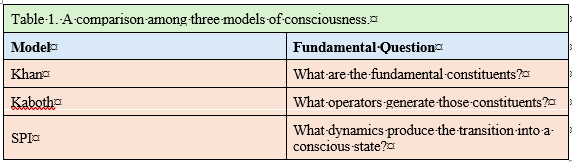
Seen in this light, the three theories need not be competitors. They may instead represent complementary levels of inquiry.
7. A Possible Synthesis
Suppose Kaboth is correct that deeper operator structures exist.
Suppose Khan is correct that stable entities such as energy and soul emerge within those structures.
Suppose SPI is correct that consciousness appears during specific dynamical transitions.
Then a unified picture begins to emerge:
Operator dynamics → Stable fields → Energy and soul → Critical transition → Conscious experience
Whether this particular sequence proves correct remains an open scientific question. Yet it illustrates how apparently competing theories may eventually fit together within a broader framework.
8. Why This Matters
The history of science often reveals a progression toward deeper explanations.
Classical mechanics explained the motion of objects.
Thermodynamics explained irreversible processes.
Quantum mechanics explained atoms.
Modern biology explained genetic information.
Perhaps consciousness requires a similar progression.
Instead of asking only what consciousness is, we may also need to ask:
What structures generate it?
What dynamics sustain it?
What transitions bring it into existence?
Each of the three models discussed here contributes a different piece of that larger puzzle.
9. Looking Ahead
Whether consciousness ultimately rests upon soul, recursive operators, transition dynamics, or some synthesis that transcends all three remains unknown.
Yet one encouraging lesson emerges from comparing these perspectives.
Scientific progress often occurs not because one idea completely replaces another, but because each reveals a deeper layer of the same reality.
Perhaps the future science of consciousness will not be built upon a single grand idea but upon a hierarchy of explanations—from constituents, to operators, to dynamical transitions.
If that proves to be the case, then the path toward understanding consciousness may resemble climbing a mountain.
Each stage reveals a broader horizon.
The summit is still hidden.
But with every step upward, the landscape becomes clearer.
References:
[1] Khan, M. S. (2026). The Philosophical Basis of Consciousness. International Journal for Multidisciplinary Research (IJFMR), Vol. 8, No. 3 (2026).
https://www.ijfmr.com/papers/2026/3/82751.pdf
[2] Kaboth, P. (2026). Field-Logical Reconstruction (unpublished manuscript circulated privately).
[3] Kaboth, P., Wende, A., & Krüger, D. Triadic Observer–Coherence Equation (KWK Framework) (current working manuscripts/preprints).
[4] Ji, S. (2026). Saddle-Point Interpretation and Thermodynamic Quantum Field Theory: Toward a Geometry of Dissipative Quantum Transitions.
https://622622.substack.com/p/saddle-point-interpretation-and-thermodynamic