Beyond the Singularity: Roger Penrose’s Nobel-Winning Theorem and the Hidden Middle Layer of Reality
Sungchul Ji, Ph.D.
Emeritus Professor of Theoretical Cell Biology
Rutgers University
1. Introduction
In 2020, Roger Penrose shared the Nobel Prize in Physics [1] for a discovery that transformed our understanding of black holes and the structure of spacetime.
The Nobel Committee recognized Penrose for demonstrating that black hole formation is a robust prediction of Einstein’s General Theory of Relativity [2] . His celebrated singularity theorem [3] showed that under very general conditions, gravitational collapse inevitably leads to a singularity [4].
For most physicists, the singularity marks the point at which spacetime itself ceases to be describable by General Relativity [2].
Yet Penrose himself has repeatedly emphasized an important point:
“A singularity [1a] is not necessarily the end of reality. It may simply (6/22/2026/20)
mark the end of a particular theory’s ability to describe reality.”
This distinction raises a profound question:
What if the singularity is not a destination but a transition?
Viewed through the lens of the Three-Layered Reality Hypothesis (TLRH) [5], Penrose’s singularity theorem acquires an unexpected new significance.
2. What Is a Singularity?
Popular accounts often describe a singularity [4] as an infinitely dense point located at the center of a black hole.
This picture is useful but somewhat misleading.
Penrose’s theorem [1] does not prove the existence of a physical point of infinite density.
Rather, it demonstrates that under certain conditions spacetime becomes “geodesically incomplete.”
In simple terms, the paths followed by matter and light can no longer be extended.
The mathematical description reaches a boundary.
Beyond that boundary, General Relativity offers no further guidance.
“The singularity therefore represents a limit of description (6/22/2026/21)
rather than a complete explanation of what exists.”
3. The Conventional Interpretation
In standard physics, the singularity is usually represented schematically as:
Observable Spacetime
↓
Singularity
↓
Unknown
The singularity appears as a wall beyond which current theory cannot proceed.
This interpretation has dominated discussions of black holes and cosmology for decades.
Yet it leaves an unsettling question unanswered.
If the singularity marks the failure of the theory, what lies beyond that failure?
4. The Three-Layered Reality Hypothesis
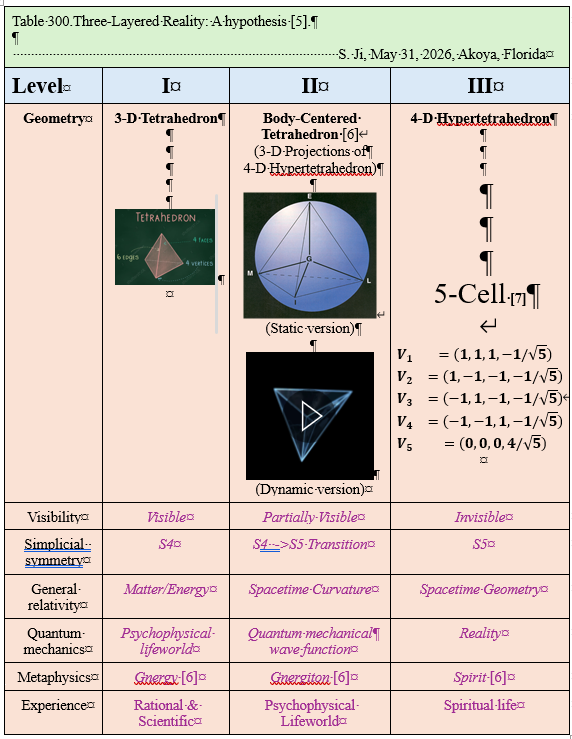
The Three-Layered Reality Hypothesis [3] proposes that reality consists of three interconnected domains.
Layer I
The observable physical world.
This is the domain investigated by conventional science and represented geometrically by the tetrahedron.
Layer II
The psychophysical lifeworld.
Represented by the Body-Centered Tetrahedron (BCT) [5] , this layer mediates between visible and invisible aspects of reality.
It includes information, meaning, consciousness, and other intermediary phenomena.
Layer III
The invisible source domain.
Represented by the hypertetrahedron or 5-cell [7], this layer is not directly observable but is inferred as the deeper source from which the lower layers emerge.
5. Reinterpreting the Singularity
Within the TLRH [4] framework, the singularity can be viewed differently.
Instead of:
Layer I
↓
Singularity
↓
Unknown
one may consider:
Layer I
↓
Layer II (Singularity as Transition)
↓
Layer III
In this interpretation, the singularity is no longer a dead end.
It becomes a boundary phenomenon.
A gateway.
A marker indicating that one mode of description has reached its limit and another mode may be required.
Importantly, this does not claim that Penrose’s theorem proves the existence of Layer III.
It does not.
Rather, the theorem demonstrates that the Layer I description becomes incomplete under extreme conditions.
The existence of such incompleteness leaves open the possibility that a deeper level of reality remains to be explored.
6. The Body-Centered Tetrahedron as Mediator
The Body-Centered Tetrahedron [5] occupies a unique position within TLRH [4].
It is neither fully visible nor fully invisible.
Instead, it serves as a mediator between the observable tetrahedron and the hidden hypertetrahedron.
This mediating role closely resembles the conceptual role played by the singularity.
The singularity is not itself the deeper reality.
Nor is it merely an ordinary feature of observable spacetime.
It stands at the boundary between two domains.
In this respect, Penrose’s singularity resembles the function assigned to Layer II.
Both represent transitional structures rather than final destinations.
7. Other Examples of Layer II Boundaries
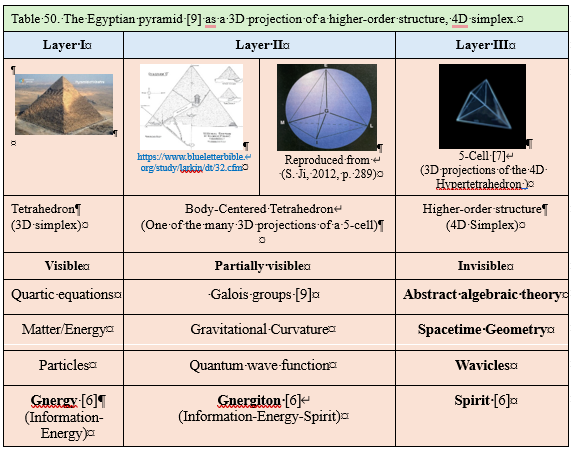
The singularity is not the only phenomenon that may be interpreted in this manner.
Many examples discussed throughout history share a similar structure:
Near-death experiences between life and death.
The Egyptian Duat between earthly and eternal existence.
Penrose’s transition between cosmic aeons in Conformal Cyclic Cosmology.
Quantum measurement between possibility and actuality.
Scientific revolutions between old and new paradigms.
In each case, a transitional domain appears between two seemingly separate realities.
These phenomena suggest that boundaries may be as important as the domains they connect.
8. A Geometric Interpretation
The geometric language of TLRH provides an illuminating metaphor.
The progression may be represented as:
S4 (Observable Reality)
↓
S4~S5 (Transitional Geometry)
↓
S5 (Deeper Reality)
Within this framework, the singularity corresponds not to the final destination but to the intermediate state.
Just as a three-dimensional projection cannot fully reveal the structure of a four-dimensional object, observable spacetime may not fully reveal the deeper reality from which it emerges.
The singularity marks the point at which the lower-dimensional description becomes insufficient.
9. Penrose’s Deeper Legacy
Penrose’s Nobel Prize [1] was awarded for a rigorous mathematical theorem, not for a philosophical speculation.
Yet the theorem’s implications reach beyond black-hole physics [10].
The singularity theorem [1] teaches a profound lesson:
Every successful scientific theory has limits.
When those limits are reached, reality does not necessarily end.
Rather, our description of reality reaches a boundary.
Throughout the history of science, such boundaries have repeatedly signaled the need for a broader framework.
Newtonian mechanics gave way to relativity.
Classical physics gave way to quantum mechanics.
“Perhaps singularities indicate another such threshold.” (6/22/2026/22)
10. Conclusion
Roger Penrose’s singularity theorem [1] remains one of the most important discoveries in modern physics because it demonstrated that General Relativity contains boundaries beyond which its own descriptions fail.
The theorem does not tell us what lies beyond those boundaries.
The Three-Layered Reality Hypothesis [4] offers one possible way of interpreting their significance.
In this view, singularities belong not to the ultimate destination of reality but to an intermediate domain that mediates between the observable and the deeper source of existence.
Whether this interpretation proves fruitful remains to be seen.
Nevertheless,
“Penrose’s theorem provides a remarkable reminder that the limits (6/22/2026/23)
of our theories should not be confused with the limits of reality itself.”
“A singularity may therefore be understood not as a wall, but as a (6/22/2026/24)
signpost toward a deeper and still unexplored layer of the cosmos.”
--------------------------------------------------------------------------------------------------------------
References:
[1] Penrose, R. (2020). Nobel Lecture: Roger Penrose, Nobel Prize in Physics 2020. https://video.search.yahoo.com/search/video;_ylt=AwrFQ_xnDDdqPwIAJc9XNyoA;_ylu=Y29sbwNiZjEEcG9zAzEEdnRpZAMEc2VjA3Nj?type=E210US1079G0&p=Roger+Penrose%2C+Nobel+Prize%2C+lecture&fr=mcafee&turl=https%3A%2F%2Ftse4.mm.bing.net%2Fth%2Fid%2FOVP.yevMkbE4r3LI-GCNqJA_6wHgFo%3Fpid%3DApi%26w%3D296%26h%3D156%26c%3D7%26p%3D0&rurl=https%3A%2F%2Fwww.youtube.com%2Fwatch%3Fv%3DDpPFn0qzYT0&tit=Nobel+Lecture%3A+Roger+Penrose%2C+Nobel+Prize+in+Physics+2020&pos=01&vid=4961080a31ce7662ad13eedd96e5d47d&sigr=eXz99BGNb2bN&sigt=FhMMhtbKexxo&sigi=.aGdnQFqo8cj
[2] General Relativity. https://en.wikipedia.org/wiki/General_relativity
[3] Singularity. https://en.wikipedia.org/wiki/Singularity
[4] Ji, S. (2026). A Geometric Worldview integrating modern physics, biology, and Jungian Synchronicity https://622622.substack.com/p/a-geometric-worldview-integrating
[5] Ji, S. (2026). The Body-Centered Tetrahedron (BCT): The Missing Link in an Emerging Geometry of Unified Cosmology
https://622622.substack.com/p/the-body-centered-tetrahedron-bct
[6] Ji, S. (2026). From Mattergy to Gnergy to Gnergitons: An ITR-Based Account of Matter, Life, and Reality
https://622622.substack.com/p/from-mattergy-to-gnergy-to-gnergitons
[7] 5-Cell. https://en.wikipedia.org/wiki/5-cell
[8] Egyptian pyramids. https://en.wikipedia.org/wiki/Egyptian_pyramids
[9] Evareste Galois. https://en.wikipedia.org/wiki/%C3%89variste_Galois
[10] Blac khole. https://en.wikipedia.org/wiki/Black_hole