Geometry and Knowledge: How the KWK Theory and the Geometry of Reality May Be Describing Different Sides of the Same Process
Sungchul Ji, Ph.D.
Emeritus Professor of Theoretical Cell Biology
Rutgers University
1. Introduction
One of the most exciting moments in science occurs when two independently developed theories begin to illuminate one another. Such moments do not necessarily mean that the theories are identical. Rather, they often reveal that each has been examining a different aspect of the same deeper phenomenon.
Recently I experienced such a moment while comparing my Geometry of Reality (GOR) [1] with the Triadic Observer–Coherence Equation [2] developed by Pasquale Kaboth, Andreas Wende, and Daniel Krüger (hereafter referred to as the KWK framework).
At first glance, the similarities appeared almost uncanny. After further study, however, I came to a different conclusion. The two theories are not duplicates. They are complementary.
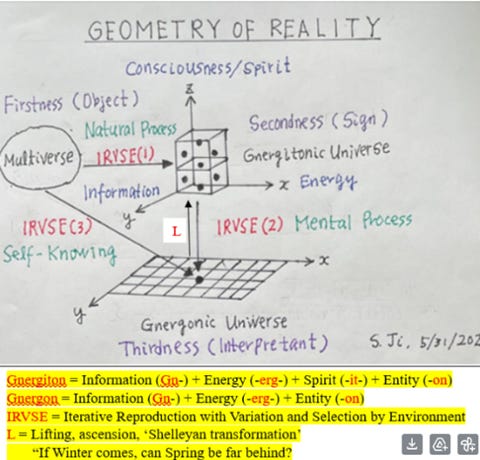
Figure 1. Two commutative triangles in GOR: IRVSE(2)◦IRVSE(1) = IRVSE(3), and L◦IRVSE(3) = IRVSE(1).

Figure 2. The geometric mechanism of generating the Fibonacci series and the Golden spiral based on the Principle of IRVSE (Iterative Reproduction with Variations and Selection by Environment).
(i) After squaring (or reproducing) 1 and adding the result to the original square, S1, you get rectangle R1 with the long side length 2.
(ii) After squaring (or reproducing) the long side of R1 and adding the result to R1, you get a rectangle R2 with the long side length 3.
(iii) After squaring (or reproducing) the long side of R2 and adding the result to R2, you get a rectangle R3 with the long side length 5.
(iv) Repeat (iii) with R3, namely, after squaring (or reproducing) the long side of R3 and adding the result to R3, you get a rectangle R4 with long side length 8.
(v) Form a spiral by connecting the opposite corners of each square with a circular arc (selected out of an infinite number of possible curves) by a conscious agent in order to achieve a desired goal.
2. Two Different Questions
The easiest way to understand the relationship is to recognize that each theory begins with a different question.
The KWK framework asks:
How does an observer reconstruct a coherent world from incomplete information?
The Geometry of Reality asks:
What is reality fundamentally made of?
One theory is primarily concerned with knowledge.
The other is primarily concerned with being.
Both questions are essential.
3. The Geometry of Reality
The Geometry of Reality (see Figure 1).proposes that reality possesses an irreducibly triadic structure [3]. Observable matter, information, consciousness, and spirit are not independent substances [4].
Instead, they are viewed as progressively richer manifestations of a deeper ontological organization represented geometrically by the simplicial hierarchy [5].
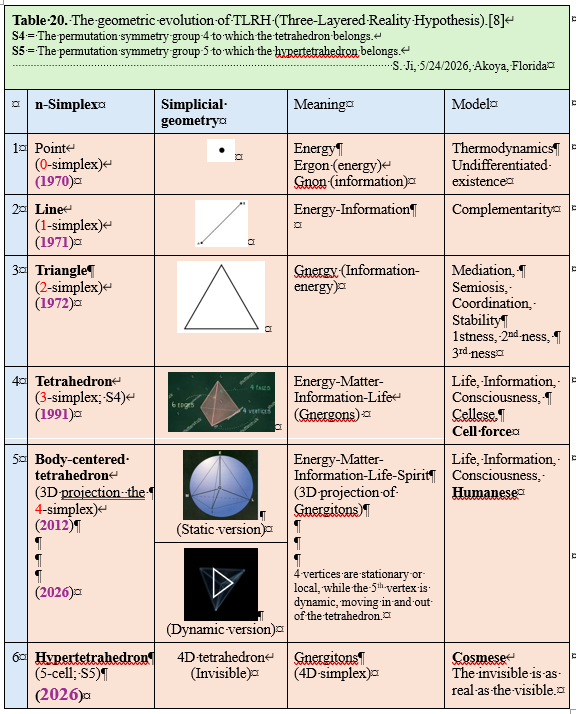
Within this framework, higher-dimensional reality gives rise to lower-dimensional appearances through processes of projection (see IRVSE(1) and IRVSE(2) in Figure 1).
The visible world is therefore understood as a partial manifestation of a deeper, largely hidden reality.
4. The KWK Framework
The KWK theory approaches the problem from a different direction.
It begins with an underlying field and asks how observers reconstruct meaningful experience.
Instead of emphasizing geometry, it emphasizes mathematical operators [6].
Reality projects information.
The observer reconstructs a coherent world (see the upward arrow L in Figure 1).
Knowledge emerges through this reconstruction process.
Its primary concern is therefore epistemology rather than ontology.
5. Projection and Reconstruction
Despite their different starting points, the two theories share a remarkably similar overall architecture.
In GOR,
deeper reality projects itself into observable forms (see IRVSE(1) and IRVSE(2) in Figure 1).
In KWK,
observable signs are reconstructed into coherent experience (see L in Figure 1).
These are opposite directions along the same conceptual pathway.
One moves downward from ontology toward observation.
The other moves upward from observation toward understanding.
6. The Three-Layered Reality Hypothesis
The relationship becomes clearer within the Three-Layered Reality Hypothesis (TLRH) [3].
Layer I consists of observable phenomena.
Layer II consists of mediating structures.
Layer III represents deeper ontological reality.
Within this framework,
GOR primarily explains the transition
Layer III → Layer II → Layer I.
KWK primarily explains the reverse direction,
Layer I → Layer II → coherent knowledge.
Thus the two theories are not competitors.
They describe opposite directions of the same bridge.
7. The Missing Middle
One of the most important developments in my own thinking over the past year has been the growing recognition of the importance of Layer II.
Originally I viewed this layer primarily through geometry, especially the Body-Centered Tetrahedron [4].
More recently it has become clear that Layer II includes a much broader class of mediating structures:
mathematics,
geometry,
language,
communication,
information,
organization,
physical law.
The KWK reconstruction operator naturally belongs within this mediating layer.
It is one example of how deeper structures become intelligible
8. From a Circle to a Helix
At first glance, the relationship between the Geometry of Reality (GOR) and the KWK framework appears circular.
GOR begins with ontology and projects downward into experience:
Layer III → Layer II → Layer I
The KWK framework begins with experience and reconstructs upward toward ontology:
Layer I → Layer II → Layer III
If these two processes were exact inverses, they would simply form a closed circle.
But scientific discovery rarely moves in circles.
It progresses.
This observation suggests a subtle but profound modification.
The destination of the reconstruction process is not exactly the original Layer III.
It is a new realization,
Layer III′.
Layer III′ does not imply that reality itself has changed.
Rather, it represents a deeper realization of reality made possible through the continual interaction between projection and reconstruction.
The process therefore becomes
GOR
Layer III
↓
Layer II
↓
Layer I
↓
KWK
↓
Layer I
↓
Layer II
↓
Layer III′
The next cycle begins not from the original ontology but from this enriched realization, producing
Layer III″,
Layer III‴,
and so on.
Reality and knowledge therefore evolve together as an ascending spiral (see Figure 3) rather than a closed loop.
9. The Vertical Helix
This idea is naturally represented by a vertical helix or a helix curve.
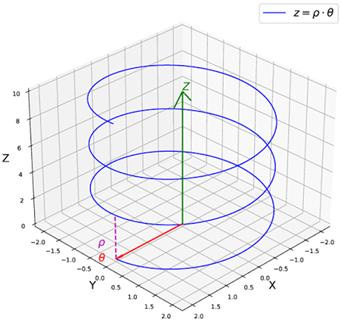
Figure 3. A helix curve.
https://www.researchgate.net/publication/384299251_Method_for_Bottle_Opening_with_a_Dual-Arm_Robot/figures?lo=1
Unlike a circle, which endlessly repeats the same path, a helix returns to the same structural relationships while ascending to higher levels of organization.
Each revolution contains the same three layers:
Ontology
↓
Mathematical mediation
↓
Observable experience
↓
Mathematical reconstruction
↓
Higher realization of ontology
The geometry repeats.
The understanding deepens.
10. The Universal Mediator
The helix also reveals something unexpected. The only layer shared by both GOR and the KWK framework is Layer II. Every descent from ontology passes through Layer II. Every ascent toward understanding also passes through Layer II.
Layer II therefore emerges as the universal mediator between being and knowing.
As already mentioned, Layer II includes:
mathematics,
geometry,
language,
communication,
information,
organization,
physical law,
observer coherence,
and scientific theories themselves.
It is here that invisible ontology becomes observable, and where observable phenomena become intelligible.
11. The Shillongator Revisited
This ascending helix immediately recalls an idea I proposed many years ago in the Shillongator [7], a model of the universe as a self-organizing and self-knowing system.

Originally, the Shillongator emphasized self-organization.
The present synthesis extends that idea.
Reality projects itself into observable form through GOR.
Observers reconstruct deeper reality through the mathematical processes described by the KWK framework [2].
Each successful reconstruction enriches the universe’s own self-description.
The universe therefore appears not merely as self-organizing, but as progressively self-knowing [7, 25].
Knowledge itself becomes an evolutionary process.
12. IRVSE as the Dynamics of the Helix
The vertical helix (Figure 3) also provides a natural geometric interpretation of Iterative Reproduction with Variation and Selection by Environment (IRVSE) (see Figure 2).
Each revolution of the helix represents one iteration.
Projection reproduces previous structure.
Observation introduces variation.
Scientific testing provides selection.
Reconstruction generates a richer realization of reality.
Thus,
Layer III
↓
Projection
↓
Observation
↓
Reconstruction
↓
Layer III′
is itself an instance of IRVSE operating on knowledge rather than on genes.
The evolution of science therefore follows the same fundamental organizational principle that governs biological evolution.
13. A Unified View
Seen in this light, four independently developed ideas become different aspects of one larger architecture.
The Geometry of Reality (GOR) [1]explains how deeper ontology projects into observable reality.
The KWK framework [2] explains how observers reconstruct coherent knowledge from those observations.
The Three-Layered Reality Hypothesis (TLRH) [8] provides the structural architecture connecting ontology, mathematics, and experience.
The Shillongator, together with IRVSE, explains why this process is not repetitive but evolutionary.
The result is not a circle of knowledge.
It is a continuously ascending helix (see Figure 3).
14. The Helical Evolution Operator
The relationship between the Geometry of Reality (GOR) and the KWK framework may now be expressed in a remarkably compact mathematical form.
Let
denote the projection operator of GOR,

mapping deeper ontology into observable reality:

Let
denote the reconstruction operator of the KWK framework,

mapping observation back toward ontology:

Notice the subtle but crucial feature.
The reconstruction does not return to the original ontology.
Instead,

The superscript (n + 1) indicates that the reconstruction represents a higher realization or deeper understanding than before.
Projection loses information.
Reconstruction does not merely recover that information.
It enriches it through observation, mathematics, experimentation, and interpretation.
The composition of the two mappings may therefore be written as
This simple equation expresses a surprisingly rich idea.

Projection alone cannot produce knowledge.
Reconstruction alone has nothing to reconstruct.
Only their continual interaction produces progressive understanding.
Repeated application gives
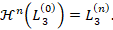
The Geometry of Reality [1] therefore provides the descending movement of ontology into appearance.
The KWK framework provides the ascending movement from appearance toward understanding.
Their composition generates the continuing evolution of knowledge.
15. Toward a Unified Geometry of Knowing
The comparison between the KWK framework and the Geometry of Reality began as an attempt to identify similarities between two independently developed theories.
It has led instead to a broader possibility.
GOR describes the projection of ontology into observable reality.
KWK describes the reconstruction of ontology from observation.
The Three-Layered Reality Hypothesis provides the architectural framework linking the two.
IRVSE supplies the dynamics of continual refinement.
The Shillongator provides the cosmological interpretation.
Together they suggest a new research program centered on a simple but profound mathematical idea:
(7/4/2026/1)

the Helical Evolution Operator (HEO).
Whether this operator can eventually be developed into a rigorous mathematical formalism remains an open scientific question.
Yet even in its present conceptual form, it suggests a striking possibility.
“The history of science may not simply be the accumulation of facts (7/4/2026/2)
It may be the repeated application of a universal helical process (UHP)
through which reality projects itself into experience, experience is
reconstructed into knowledge, and knowledge continually ascends toward
deeper realizations of reality.”
In that sense,
“Science is not merely humanity’s effort to understand the universe. It may (7/4/2026/3)
be one of the ways the universe gradually comes to understand itself [7]’.
16. Process KL Revisited
In an earlier article I suggested that the KWK reconstruction operator and GOR’s Process L might be identical.
I now believe a more accurate statement is possible.
Process L should be understood as a possible ontological realization of the mathematical reconstruction described by the KWK framework.
The two operations are not necessarily identical.
Rather, they appear to perform analogous functions within different theoretical contexts.
This distinction strengthens both theories.
17. Ontology and Epistemology
The comparison also illustrates an idea that has become central to the Geometry of Reality.
Reality cannot be understood through ontology alone.
Nor through epistemology alone.
Mathematics serves as a bridge between the two.
This leads naturally to what I have called the Ontology–Epistemology–Mathematics Triad (OEMT) [3].
Ontology asks:
What exists?
Epistemology asks:
How do we know it?
Mathematics provides the language that connects the two.
The KWK framework primarily explores the mathematical route from observation to knowledge.
GOR primarily explores the geometric route from ontology to observation.
Together they illuminate the entire triad.
18. A New Interpretation
Seen from this broader perspective, the two theories complement one another.
GOR explains why observable reality may appear as it does.
KWK explains how observers transform those appearances into meaningful knowledge.
One begins with the world.
The other ends with understanding.
Between them lies the rich mediating domain of mathematics, geometry, information, and organization.
19. Looking Ahead
Neither theory is complete.
The Geometry of Reality still seeks a fully developed mathematical formalism capable of describing projection, organization, and actualization.
The KWK framework continues to develop mathematical operators describing reconstruction and observer coherence.
These are not weaknesses.
They are opportunities.
The future may reveal that projection and reconstruction are complementary aspects of a single underlying process.
20. Conclusion
Perhaps the deepest lesson from comparing these two frameworks is that scientific theories often illuminate different faces of the same reality.
The Geometry of Reality [1] asks where the world comes from.
The KWK framework [2] asks how we come to know that world.
Between these two questions lies mathematics—the remarkable language that allows hidden order to become visible.
If future work confirms these connections, projection and reconstruction may eventually be recognized as complementary operations linking ontology and epistemology within a unified geometric view of reality [1].
The universe would then appear not merely as a collection of objects, but as an ongoing dialogue between being and knowing, mediated by the timeless language of mathematics [8].
References:
[1] Ji, S. (225). The Geometry of Reality (GOR): A Triadic Framework for Matter, Mind, and Spirit.
https://622622.substack.com/p/geometry-of-reality
[2] Pasquale, K. (2026). SBoC-F email dated June 29, 2026. Re: [SBoC-F] Fwd: Shareable assets for: Does Consciousness Collapse the Wavefunction
[3] Ji, S. (2026) Reality Requires Three: Why Ontology, Epistemology, and Mathematics Form an Irreducible Triad. https://622622.substack.com/p/reality-requires-three-why-ontology
[4] Ji, S. (2018). The Cell Language Theory: Connecting Mind and Matter. World Scientific Publishing, New Jersey. P. 423. BCT
[5] Simplicial complex. https://en.wikipedia.org/wiki/Simplicial_complex
[6] Operator. https://en.wikipedia.org/wiki/Operator_(mathematics)
[7] Ji, S. (1991). A Biological Model of the Universe: The Shillongator. In: Molecular Theories of Cell Life and Death (S. Ji, ed.), Rutgers University Press, New Brunswick, N.J.
P. 53.
[8] Ji, S. (2026). Reality May Require Three: From Egyptian Pyramids to Quantum Mechanics, Relativity, and the Self-Knowing Universe. https://622622.substack.com/p/reality-may-require-three-from-egyptian