Does Consciousness Collapse the Wavefunction? Penrose, Faggin, and Three Visions of Quantum Reality
Sungchul Ji, Ph.D.
Emeritus Professor of Theoretical Cell Biology
Rutgers University
1. Introduction: One of Physics’ Greatest Mysteries
Quantum mechanics is the most successful scientific theory ever developed.
It predicts the behavior of atoms, molecules, semiconductors, lasers, and countless other phenomena with astonishing precision.
Yet it leaves one profound question unanswered.
How does possibility become actuality?
Before measurement, a quantum system is described by a wavefunction representing many possible outcomes.
After measurement, only one outcome remains.
This transition is known as wavefunction collapse [1].
For nearly a century, physicists have debated [2] what causes this collapse.
Among the most intriguing participants in this debate are Sir Roger Penrose [3] and Federico [4]Faggin.
Although both reject a purely mechanical interpretation of reality, they arrive at very different conclusions.
2. The Traditional Puzzle
According to standard quantum mechanics, the wavefunction evolves smoothly according to Schrödinger’s equation [5].
Nothing in that equation predicts the sudden appearance of a single observed outcome.
“The mathematics describes possibilities. Observation reveals one actuality. (6/28/2026/1)
What bridges the two?
This question is known as the measurement problem [6].
3. Penrose: Collapse as an Objective Physical Process
Roger Penrose believes that collapse is not caused by observation.
Nor does he think consciousness creates reality.
Instead, he proposes that collapse is an objective physical process.
According to his idea of Objective Reduction (OR) [7], certain quantum superpositions become unstable because they involve incompatible spacetime geometries.
When the gravitational difference between those geometries reaches a critical threshold, the superposition spontaneously collapses.
In Penrose’s view:
quantum collapse is a genuine physical event,
gravity plays an essential role,
consciousness depends upon such collapse events occurring within the brain.
The sequence is therefore:
Quantum gravity
↓
Objective reduction
↓
Consciousness
Consciousness does not create collapse.
Collapse contributes to consciousness.
4. Faggin: Consciousness Comes First
Federico Faggin approaches the problem from the opposite direction.
For him, consciousness is not produced by matter.
Consciousness is fundamental.
The physical universe emerges from conscious reality rather than the reverse.
Faggin argues that every conscious subject is unique and irreducible.
One reason he emphasizes the quantum no-cloning theorem [8] is that it demonstrates that unknown quantum states cannot be perfectly copied.
He sees this uniqueness as consistent with the uniqueness of conscious experience.
In his worldview:
Consciousness
↓
Quantum events
↓
Physical reality
Collapse therefore becomes an expression of conscious agency rather than its cause.
5. Two Opposite Directions
The contrast between Penrose and Faggin is striking.
Penrose begins with physics and arrives at consciousness.
Faggin begins with consciousness and arrives at physics.
Both reject a purely materialistic picture.
But they reverse the direction of explanation.
6. A Third Possibility: Organization
There may be another way to approach the problem.
The Gnergy Principle of Organization (GPO) [9, 9a] begins with neither gravity nor consciousness alone.
Instead, it starts from a simple observation.
Organization always requires two complementary ingredients:
energy, to perform work,
information, to guide work.
Neither is sufficient by itself.
Together they produce organized systems.
This principle suggests a different way of viewing wavefunction collapse.
7. From Possibility to Organization
Before collapse, quantum systems explore many possibilities.
During collapse, one possibility becomes actual.
From the standpoint of the GPO [9] , this transition represents more than the loss of quantum coherence.
It is also the moment at which:
energy is irreversibly dissipated,
information is selected,
organization increases.
The transition from possibility to actuality therefore becomes an organizational event.
8. The Saddle Point
Recent work[10] extends this idea using the Generalized Franck–Condon Principle [11].
Fast quantum processes occur on femtosecond timescales.
Biological and classical processes unfold much more slowly.
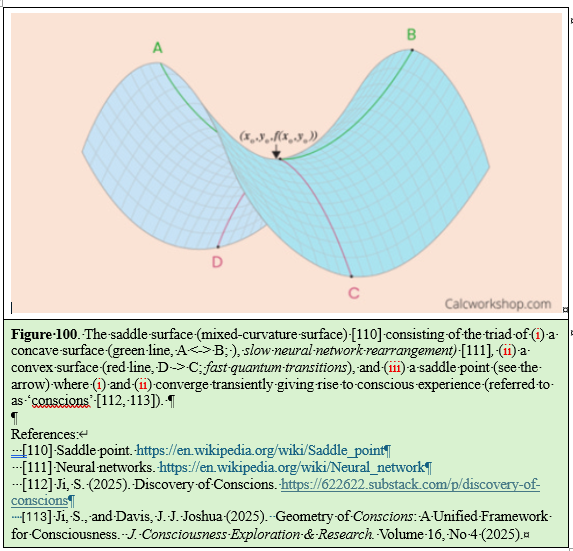
At certain saddle points, these two regimes become coupled.
The quantum event transfers energy into slower degrees of freedom (e.g., enzyme catalysis [12]).
The environment records the outcome.
One possibility becomes actual.
Collapse, in this interpretation, is neither purely mental nor purely gravitational.
It is the irreversible emergence of organized reality (see Figure 100 below).
9. Three Perspectives
The three approaches may be summarized simply.
Penrose
Physical geometry
↓
Objective collapse
↓
Consciousness
Faggin
Consciousness
↓
Quantum events
↓
Physical reality
Gnergy Principle
Information + Energy
↓
Organization
↓
Actuality
Each begins from a different starting point.
Each attempts to explain the same mystery.
10. A Triadic Perspective
The Three-Layered Reality Hypothesis [13] suggests that these approaches need not be mutually exclusive.
Layer I contains observable physical events.
Layer II contains mediating mathematical and organizational processes.
Layer III represents deeper ontology.
From this perspective:
Penrose primarily explores the geometry connecting Layers I and II.
Faggin emphasizes the ontological priority of Layer III.
The Gnergy Principle focuses on the organizational bridge that transforms potentiality into actuality.
Rather than competing explanations, they may illuminate different aspects of the same deeper process.
11. A Shared Goal
Despite their differences, Penrose and Faggin agree on something important.
Neither believes that the standard interpretation of quantum mechanics [14] provides the final answer.
Both argue that reality is richer than conventional materialism suggests.
One looks toward geometry.
The other toward consciousness.
Both invite us to reconsider what lies beneath the observable world [10].
12. Conclusion
The mystery of wavefunction collapse remains unsolved [2].
Roger Penrose seeks its origin in the geometry of spacetime.
Federico Faggin seeks its origin in consciousness itself.
The Gnergy Principle of Organization proposes that collapse reflects a transition in which energy, information, and organization become irreversibly linked.
Whether any of these ideas proves correct remains to be seen.
But together they remind us of something profound.
The deepest questions in science are no longer confined to physics alone.
They now reach into biology, information theory, philosophy, and the study of consciousness.
Perhaps the ultimate solution will not come from choosing between geometry and consciousness.
Perhaps it will emerge from discovering the deeper principles that connect them
_______________________________________________________________________
References:
[1] Wave function collapse. https://en.wikipedia.org/wiki/Wave_function_collapse
[2] Quantrum Consciousness Debate. https://video.search.yahoo.com/search/video;_ylt=AwrFYgbDckFqUAIAgupXNyoA;_ylu=Y29sbwNiZjEEcG9zAzEEdnRpZAMEc2VjA3Nj?p=quantum+consciousness+debate%2C+Penrose&fr=mcafee&rurl=https%3A%2F%2Fwww.youtube.com%2Fwatch%3Fv%3D0nOtLj8UYCw
[3] Penrose, R. (2020). Nobel Lecture: Roger Penrose, Nobel Prize in Physics 2020
[4] Federico Faggin. https://en.wikipedia.org/wiki/Federico_Faggin
[5] Standard model. https://en.wikipedia.org/wiki/Federico_Faggin
[6] Measurement problem.https://en.wikipedia.org/wiki/Measurement_problem
[7] Objective orchestrated reduction.
https://en.wikipedia.org/wiki/Orchestrated_objective_reduction
[8] No-cloning theorem.https://en.wikipedia.org/wiki/No-cloning_theorem
[9] Ji, S. (2018). The Cell Language Theory: Connecting Mind and Matter. World Scientific Publishing, New Jersey. Pp. 33-34. GPO
[9a] Ji, S. (2025). Discovery of Conscions. https://622622.substack.com/p/discovery-of-conscions
[10] Saddle-Point Interpretation and Thermodynamic Quantum Field Theory: Toward a Geometry of Dissipative Quantum Transitions
https://622622.substack.com/p/saddle-point-interpretation-and-thermodynamic
[11] Ji, S. (1991). A Biological Model of the Universe: The Shillongator. In: Molecular Theories of Cell Life and Death (S. Ji, ed.), Rutgers University Press, New Brunswick, N.J. P. 53.
[12]Ji, S. (2012). Micro-Macro Coupling in the Human Body. In: Molecular Theory of the Living Cell: Concepts, Molecular Mechanisms, and Biomedical Applications. Springer, New York. Pp.343-368.
[13] Ji, S. (2026). A Geometric Worldview integrating modern physics, biology, and Jungian Synchronicity https://622622.substack.com/p/a-geometric-worldview-integrating
[14] Interpretations of quantum mechanics.https://en.wikipedia.org/wiki/Interpretations_of_quantum_mechanics
[15] S. (2026). The Body-Centered Tetrahedron (BCT): The Missing Link in an Emerging Geometry of Unified Cosmology
https://622622.substack.com/p/the-body-centered-tetrahedron-bct
This is always a problem when searching for something that doesn't exist in our normal perception of reality and existence. The rules seem to hold true but the essence has no existence in our reality. Perhaps it is beyond our ability to codify, numerate or describe. It just is.
Btw ‘Penrose and Faggin’ sound more like what you say when you stump your toe in the door. Intuition, humor… ignorance is bliss sometimes