Are Interpretants Arbitrary? (Reference 11 modified)
A Triadic Resolution of a Hidden Problem in Semiotics
Sungchul Ji, Ph.D.
Emeritus Professor of Theoretical Cell Biology
Rutgers University
Abstract
The arbitrariness of the sign [1] is a foundational principle in semiotics, most clearly articulated by Ferdinand de Saussure. However, whether the interpretant—the third component in Charles Sanders Peirce’s triadic model [2]—is also arbitrary remains unclear. In this article, I present a simple but revealing case study: two independent AI systems, Gemini and ChatGPT, interpreting the same concept (“gnomonics”[2a]) applied to the same object (the author’s work), yet producing different interpretants. I argue that this divergence does not demonstrate arbitrariness, but rather reveals a deeper principle: interpretants are variational but constrained, arising through a triadic selection process. This result supports the universality of the Irreducible Triadic Relation (ITR) [3] and aligns with the IRVSE (Iterative Reproduction with Variations followed by Selection by Environment) framework [4].
1. The Classical View: Arbitrary Signs
In modern semiotics, largely shaped by Ferdinand de Saussure [5], the relationship between a word and what it represents is arbitrary.
There is nothing inherent in the sound “tree” that connects it to the physical object we call a tree. Another language could use a completely different sound.
This principle—the arbitrariness of the sign [1]—has been widely accepted.
2. Peirce’s Expansion: The Triadic Model
Charles Sanders Peirce [6] expanded this into a three-part structure:
Sign – the form (e.g., “gnomonics”)
Object – what it refers to (S. Ji’s work)
Interpretant – the meaning generated in a mind or system
This triadic structure is what I have called the Irreducible Triadic Relation (ITR) [3].
3. The Key Question
If the sign is arbitrary, what about the interpretant?
Is meaning itself arbitrary?
Or is it governed by deeper constraints?
4. A Natural Experiment: Two AIs, One Concept
To explore this question, I constructed Table 1 below based on two independent interpretations of my work:
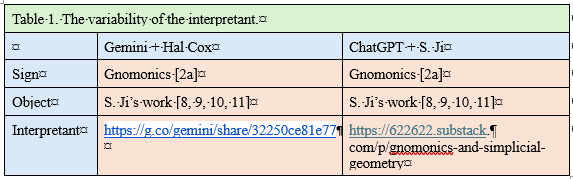
Two Interpretations of the Same Sign–Object Pair
Sign: “Gnomonics” [2a]
Object: S. Ji’s theoretical framework [7]
Interpretant (Gemini): External explanatory link (see the last row of Table 1)
Interpretant (ChatGPT): Substack article integrating semiotics and geometry (see the last row of Table 1).
Observation
The Sign is identical
The Object is identical
The Interpretants differ
At first glance, this suggests:
“Interpretants are arbitrary.”
But this conclusion is misleading.
5. Why This Is Not Arbitrariness
If interpretants were truly arbitrary, we would expect:
Completely unrelated meanings
Random or incoherent outputs
No structural connection to the object
But what we observe instead:
Both interpretations are about the same conceptual domain
Both preserve core structure and intent
Differences lie in presentation, emphasis, and abstraction level
👉 Therefore:
“The interpretants are different—but not arbitrary” (3/31/2026/1).
6. The Correct Principle: Constrained Variability
This leads to a more precise formulation:
Interpretant Principle (Ji, 2026)
“For a given Sign–Object pair, multiple interpretants may arise, but
all valid interpretants are constrained by the structure of the object” (.3/31/2026/2)
7. A Triadic Reformulation
We can express this formally:
(3/31/2026/3)

Where:
The Sign provides symbolic input
The Object provides structural constraints
The Interpreter (human, AI, or biological system) generates variation
This is not a dyadic process, but an irreducibly triadic one.
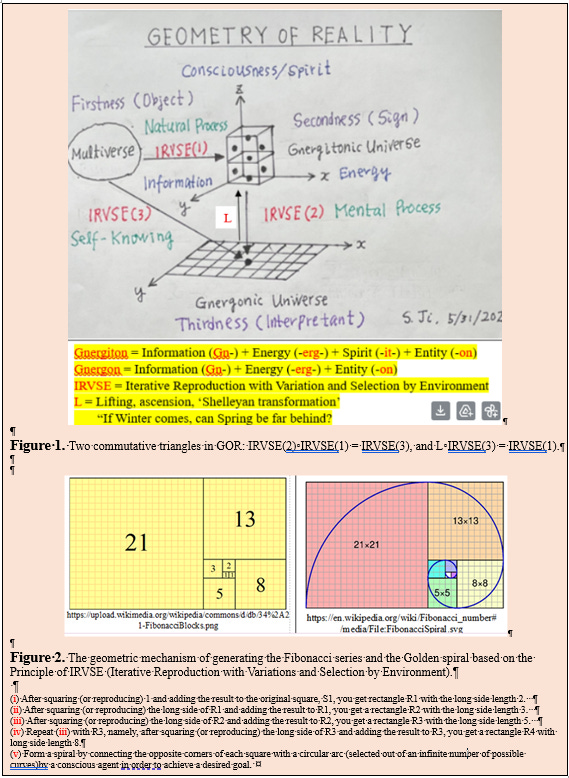
8. Connection to IRVSE (defined in the legend to Figure 2)
This behavior mirrors your fundamental principle:
IRVSE (Iterative Reproduction with Variations followed by Selection by Environment)
Multiple interpretants = variations
Coherence with the object = selection
Thus, meaning itself is an evolutionary process.
9. Avoiding a Logical Fallacy
A common mistake would be to conclude:
“Interpretants are either fixed or arbitrary.”
This is a classic case of your:
False Disjunction Bias (FDB)
The correct formulation is:
“Interpretants are neither fixed nor arbitrary, but constrained variations.” (3/31/2026/4)
10. A New Concept
To capture this insight, I propose:
Constrained Interpretant Variability (CIV)
or equivalently,
The Semiotic Selection Principle (SSP)
“Meaning emerges through variation, but is selected by coherence with reality.” (3/31/2026/5)
11. Implications for Science and Philosophy
This insight has far-reaching implications:
(i) Language
“Meaning is not free—it is constrained by structure.” (3/31/2026/6)
(ii) Biology
“mRNA → RNA QR code → phenotype.” (3/31/2026/7)
Interpretation is structured translation, not arbitrary mapping.
(iii) Artificial Intelligence
“Different models produce different outputs (3/31/2026/8)
—but all must remain anchored to reality.”
(iv) Physics and Consciousness
“Observation (interpretation) is not arbitrary— (3/31/2026/9)
it is constrained by the structure of the system.”
12. Conclusion
Table 1 reveals a profound truth:
Meaning is not arbitrary—it is selected.
Interpretants are:
Not fixed
Not arbitrary
But variationally constrained outcomes of a triadic process
This supports the universality of:
The Irreducible Triadic Relation (ITR) [3]
The IRVSE mechanism of reality generation (Table 2)